Zhoris Guismans
 France
Biography of Joris-Karl Huysmans
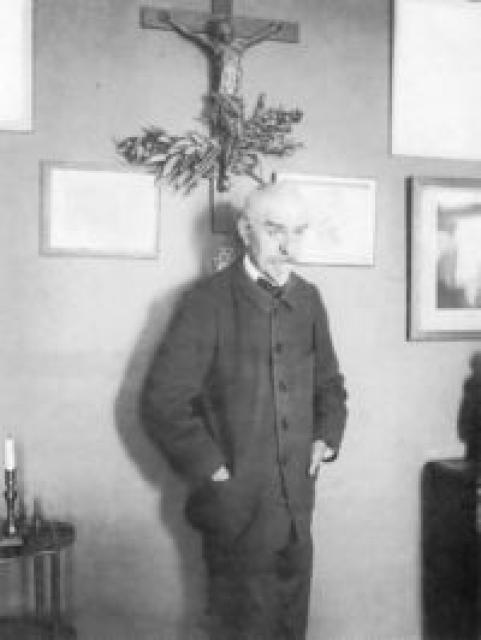
Joris-Karl Huysmans (officially Charles-Georges-Marie Huysmans) was a French writer of Dutch origin. He was born on February 5, 1848, and passed away on May 12, 1907. Huysmans served as the first president of the Goncourt Academy from 1900. Throughout his life, he worked as a civil servant for the Ministry of the Interior since 1866. In 1874, he published his first book, "A Basket of Spices," a collection of prose poetry influenced by Baudelaire and Aloysius Bertrand. From this time onwards, he adopted the "Germanized" version of his name (Joris-Karl) to emphasize his Dutch roots. He typically signed his works with his initials rather than his full name: J.-K. Huysmans.
During the 1870s and 1880s, Huysmans aligned himself with the naturalist school of literature, producing novels such as "Marta" in 1876, "The Vatard Sisters" in 1879, and "At the Dock" in 1886. He also participated in the publication of the collective anthology "Les Soirées de Médan" in 1880 and worked as an art critic.
His novel "Against Nature," written in 1884, is considered a manifesto of European decadence at the end of the 19th century. The main character, des Esseintes, is an aristocrat who harbors disgust towards the surrounding world, living alone in a country house and indulging in refined and perverse pleasures. The novel extensively describes ancient and contemporary authors, whose works make up des Esseintes' library. During this time, Huysmans moved away from naturalism and embraced mysticism. His novel "Down There" (also known as "Là-Bas" in French, 1891) depicts a circle of contemporary Satanists and is renowned for its description of a black mass. He also worked on an unfinished novel titled "Up There" during this period.
In 1892, Huysmans converted to Catholicism. He wrote a book about Saint Lydwine of Schiedam in 1901. In his novel "The Cathedral" (1898), Huysmans explores the symbolism of medieval architecture. In 1905, he was diagnosed with cancer. According to his religious beliefs, he refused treatment and passed away two years later. He was posthumously awarded the Legion of Honor. Huysmans was buried in the Montparnasse Cemetery.