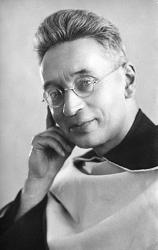
Abbot Pier
 France
Biography of Abbe Pierre
Abbe Pierre, the most popular person in France, was born on August 5, 1912, in Lyon, to a wealthy family. He studied at a Jesuit college and at the age of 19 entered a Capuchin monastery in his hometown. During his seven years in the monastery, he completed his studies in philosophy and theology.
During World War II, this young vicar helped Jews cross the Swiss border. It was during this time that he acquired an underground nickname, which would later become his second name - Abbe Pierre. After the war, Abbe Pierre returned to France, where he was elected as a deputy in the National Assembly for the People's Republican Movement - the Christian Democratic Party. His experience in the Resistance convinced him that the primary task of a Christian is to do everything possible to prevent violence.
Together with the British doctor John Boyd Orr, who later received the Nobel Peace Prize, Abbe Pierre founded the "Universal Movement for a World Confederation." He left his parliamentary activities in 1951. Shortly before that, Abbe Pierre acquired an old, semi-ruined house on the outskirts of Paris, which he restored with the help of volunteers. He turned it into a shelter for orphans whose parents had died on both sides of the barricades during the war. He named this shelter "Emmaus" after the Palestinian village where disciples encountered the resurrected Christ.
In the winter of 1953-1954, Abbe Pierre forced the Minister of Reconstruction and Housing to attend the funeral of a child who died from cold in a van on the same day when the Senate voted against allocating funds for the needs of the homeless, through the newspaper Le Figaro. In France, it was customary for priests to live modestly but respectably, so, as Abbe Pierre himself recounts, "the shock that a priest, who had also received the Legion of Honor for his participation in the Resistance and was a former deputy, lived among swindlers and ex-convicts and demanded the construction of homes for homeless families, was so great that France began to move forward." Abbe Pierre is the recipient of international awards and honors, and his books have been translated into many languages. In 1992, he received the Order of the Legion of Honor and was nominated for the Nobel Peace Prize. Until his last days, he lived modestly in the Emmaus community in Esteville, Normandy, together with the elderly and sick, whom he continued to care for while awaiting his "great leave." That's how he referred to his passing and transition to the Kingdom of Heaven.
For 17 years, Abbe Pierre ranked first in the list of the most popular French people according to a survey conducted every six months by the French Institute of Public Opinion. Abbe Pierre became known not only for his charitable work, but also for his progressive views on church life and traditions, which contradicted the statutes of the Catholic Church. In 2005, he published a book in which he admitted to breaking his vow of celibacy and did not consider it something terrible. "I took a vow of celibacy. It was not shaken by a fleeting passion. It happened to me - I was temporarily overwhelmed by it, but I never had a regular love affair because I never allowed the sexual desire to take root in me," wrote Abbe Pierre. In the same book, he did not exclude the possibility that Jesus Christ could have fallen in love with Mary Magdalene. Abbe Pierre mentions several cases where members of the clergy lived with women, but still "remained good priests."
Furthermore, in his book, he wrote that he "will never understand why Pope John Paul II and Cardinal Ratzinger argued against ordaining women."