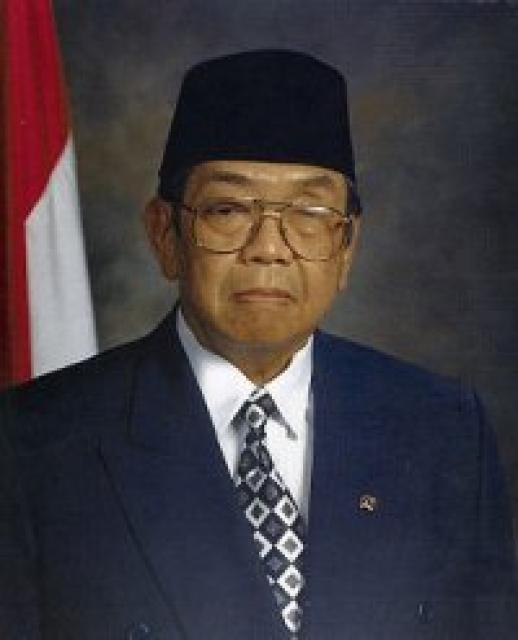
Abdurrahman ad-Dakhil Wahid
 Indonesia
Early Life and Education
Abdurrahman Wahid, commonly known as "Gus Dur," was born in Jombang, East Java, Indonesia. He was the grandson of K.H. Hasyim Asy'ari, the founder of the Nahdlatul Ulama (NU), the country's largest Islamic organization. His father, K.H. Abdul Wahid Hasyim, served as Minister of Religious Affairs in the government of President Sukarno.
Wahid attended school in Yogyakarta and later studied at Al-Azhar University in Cairo, Egypt, and the University of Baghdad in Iraq. He returned to Indonesia in 1971 and embarked on a career as a journalist and lecturer in Islamic institutions.
Leadership in Nahdlatul Ulama
In 1978, Wahid became the First Secretary of the NU, and in 1984, he was elected as its Chairman. Under his leadership, the NU evolved into a more progressive and politically active organization. Despite resistance from President Suharto, Wahid was re-elected as NU Chairman in 1994.
Political Career
After the financial crisis of 1997, Suharto's grip on power weakened, leading to his resignation in 1998. In the same year, Wahid founded and возглавил the National Awakening Party (PKB), an Islamic-based political party.
In 1999, Wahid was elected President of Indonesia. However, his presidency was marked by economic challenges and political instability. He faced opposition from various groups, including the military. In 2001, the Indonesian Parliament unanimously voted to impeach Wahid, who subsequently resigned.
Legacy
Gus Dur's presidency was a period of both hope and disappointment. Although he failed to improve the economic situation, he is remembered for his efforts to promote religious tolerance and social justice. He left a legacy as a charismatic and influential figure in Indonesian politics and Islam.


