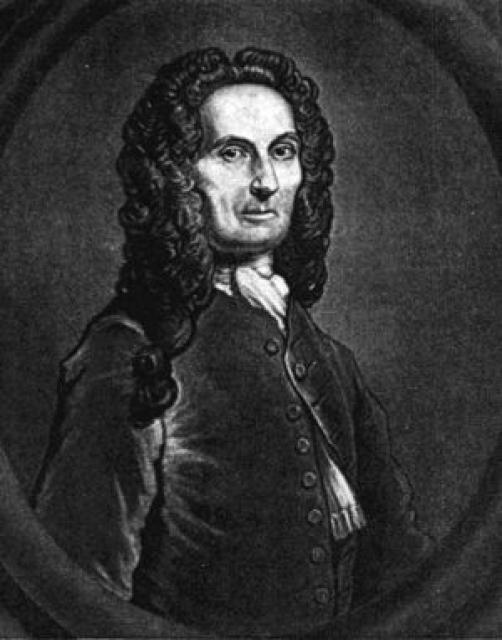
Abraham Muavr
 France
- Biography of Abraham de Moivre
- Early Life and Education
- Contributions to Mathematics and Friendship with Newton
- Contributions to Probability Theory and Analysis
Biography of Abraham de Moivre
Abraham de Moivre was a French mathematician who made significant contributions to the development of analytical trigonometry and probability theory. He was born in France, into a non-noble Huguenot family, and added the particle "de" to his surname on his own initiative.
Early Life and Education
At the age of 11, de Moivre entered the Protestant Academy in Sedan, where he studied for four years before the academy was banned by the authorities in 1682. He continued his education in Saumur for another two years, during which time he likely became acquainted with the theory of probability through the works of Christiaan Huygens.
Afterward, de Moivre attended lectures on physics and mathematics in Paris for about a year. However, in 1685, Louis XIV officially revoked the Edict of Nantes, leading to renewed persecutions of Protestants. De Moivre found himself imprisoned, but the details of his confinement remain unknown. Nevertheless, he was forced to leave his homeland. In 1688, he settled in London, where he spent the rest of his life. He supported himself through private tutoring, and soon became known as a talented mathematician. However, as a foreigner, he had no chance of obtaining a professorship at an English institution. The religious discrimination was replaced by national discrimination.
Contributions to Mathematics and Friendship with Newton
Shortly before his arrival in London, Isaac Newton's book "Mathematical Principles of Natural Philosophy" was published in three volumes. De Moivre was so enthralled by it that he dissected the book and constantly carried with him a portion to read, so as not to waste time during his travels between students. In 1692, de Moivre met Edmond Halley, and through him, he became acquainted with Newton. They soon became close friends, and Newton held de Moivre in extremely high regard. According to rumors of the time, when visitors bothered Newton with trivial mathematical matters, he would dismiss them by saying, "Go to de Moivre; he understands this better than me." De Moivre also constantly assisted Newton in the publication and editing of his works, particularly "Opticks."
Contributions to Probability Theory and Analysis
In 1695, de Moivre published his first work on analysis, "The Method of Fluxions." In 1697, he was elected a Fellow of the Royal Society of London. In 1710, he participated in a committee that resolved the priority dispute between Newton and Gottfried Wilhelm Leibniz. In 1718, de Moivre published his major work on probability theory, titled "The Doctrine of Chance: A method of calculating the probabilities of events in play." The book generated considerable interest and went through three editions.
In 1722, de Moivre published his formula, known as de Moivre's formula, for exponentiating (and extracting roots of) complex numbers expressed in trigonometric form. He was the first to use exponentiation with infinite series. He and James Stirling are credited with the asymptotic representation of the factorial, known as Stirling's formula.
Besides his work in analysis, de Moivre made significant contributions to probability theory. He proved specific cases of Laplace's theorem and conducted probabilistic studies of gambling games and various statistical data on populations. In addition to the normal distribution, he also used the uniform distribution. For the discrete case, he extensively studied and analyzed sequences now known as de Moivre sequences. Many of de Moivre's results were soon overshadowed by Laplace's works, and the extent of de Moivre's possible influence on Laplace remains unclear.
De Moivre was a member of the Royal Society of London (1697), the Paris Academy (1754), and the Berlin Academy (1735).


