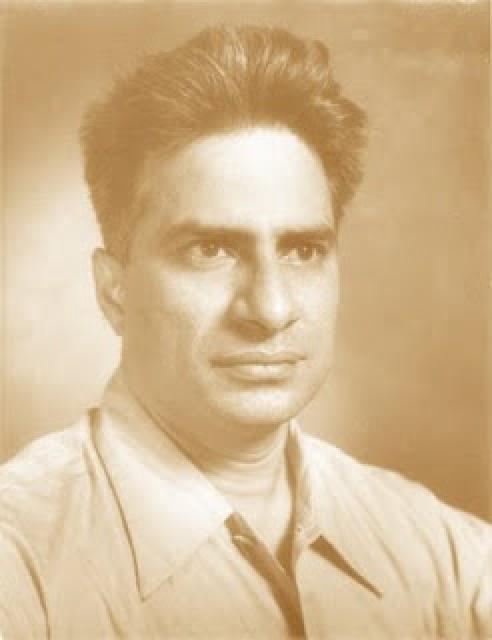
Damodar Dharmananda Kosambi
 India
India- Biography of Damodar Dharmanand Kosambi
- Early Life and Education
- Education in the United States
- Academic Career and Contributions
- Political Activism
Biography of Damodar Dharmanand Kosambi
Damodar Dharmanand Kosambi was an Indian mathematician, statistician, philologist, historian, Marxist thinker, and social activist.
Early Life and Education
Kosambi was born in Kosben, near Goa (Panaji), which was under Portuguese rule at the time. His father, Dharmanand Damodar Kosambi, came from a Brahmin caste but later became a Buddhist and spent a significant part of his life in wanderings. Kosambi senior was one of India's leading philologists, which greatly influenced the atmosphere in which his son was raised. At the age of eight, Damodar Dharmanand Kosambi completed his primary education.
Education in the United States
In 1918, Kosambi and his older sister, Mannk Kosambi, accompanied their father, who was invited by Harvard University to work with Buddhist sources, to Massachusetts. In 1920, Kosambi enrolled in a prestigious Latin school in Cambridge. It was there that he met and befriended Norbert Wiener, a renowned mathematician, whose father had collaborated with Kosambi senior. Unlike most of his peers, Kosambi did not focus on a single subject but successfully combined the study of mathematics, natural sciences, and social sciences. After excelling in his school exams, Kosambi received an offer to attend Harvard University but interrupted his studies in 1924 and returned to India to participate in the national liberation movement (his father, who had returned to Gujarat University, was a close associate of Mahatma Gandhi). The Kosambi family returned to the United States in 1926, and in 1929, Damodar Dharmanand received his Harvard degree.
Academic Career and Contributions
Upon returning to India, Kosambi taught mathematics and German language at Banaras Hindu University (1930) and Aligarh Muslim University (1931), where he was invited by Andre Weil. Kosambi's articles on differential geometry, mathematical analysis, astronomy, and physics, including "Precession of Elliptical Orbits," began to be published in Indian, Italian, and German publications. From 1933 to 1945, Kosambi worked at Fergusson College in Pune, teaching mathematics and working on graph theory. In 1944, he published a small four-page article presenting his map function. Additionally, during this period, Kosambi made significant contributions to the historical science of India. As an avid numismatist, he devoted considerable attention to the scientific study of numismatics and the use of mathematical and historical methods.
In 1945, Homi Jehangir Bhabha offered Kosambi a position as a professor of mathematics at the Tata Institute of Fundamental Research (Institute of Social Sciences) in Bombay. Kosambi's work at the Tata Institute (from 1945 to 1962) is considered a crucial period of his scientific career. In 1965, his major historical work, "An Introduction to the Study of Indian History" and "Culture and Civilization of Ancient India," was published. In these works, Kosambi interpreted the history and cultural tradition of India based on the principles of historical and dialectical materialism.
Political Activism
Starting from the final stage of the struggle for India's independence, Kosambi aligned with the left, including the Communist Party of India. While supporting Jawaharlal Nehru's foreign policy and his socialist principles, Kosambi harshly criticized the internal policies of the Indian leadership, considering them concessions to the bourgeoisie. This strained his relationship with the authorities and led to his departure from the Tata Institute. He welcomed the Maoist leadership of the People's Republic of China (he was a frequent guest in China from 1952 to 1962) and actively participated in the peace movement as a member of the International Peace Council. Establishing contacts with like-minded individuals and participating in world congresses, Kosambi visited Moscow, Beijing, and Helsinki several times. Kosambi's daughter, Mira Kosambi, is a sociologist and feminist activist.