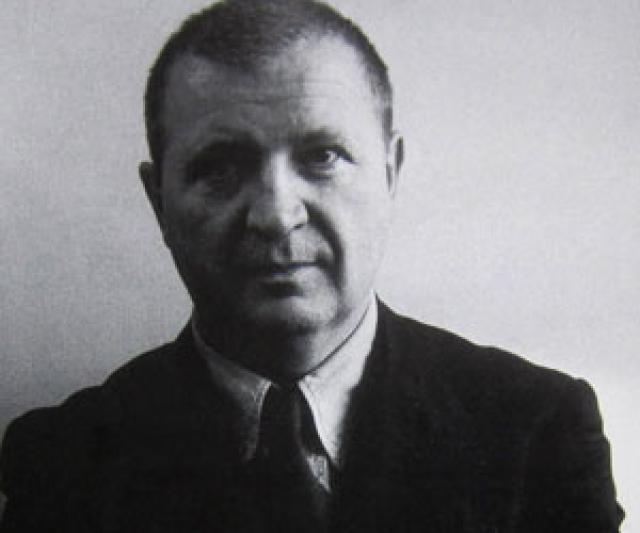
Ad Reinhardt
 USA
USABiography of Ed Reinhardt
Ed Reinhardt was an American abstract artist whose career in New York began in the 1930s and continued until his death in 1967. He was a member of the 'American Abstract Artists' association and belonged to the movement formed around Betty Parsons Gallery, known as abstract expressionism. Additionally, Reinhardt was the founder of the 'Artist's Club' in New York. He was a prolific writer, regularly giving lectures on art, and had a significant influence on the development of conceptual art, minimalism, and monochromatic painting. He believed in the philosophy of art that he called 'Art-as-Art'.
Early Life and Education
Ed Reinhardt was born on December 24, 1913, in Buffalo, New York. He initially lived with his family in the Riverside area along the Niagara River but had to move to New York City due to his father's work. Reinhardt studied art history at Columbia University, where he formed close relationships with poet Robert Lax and future theologian and monk Thomas Merton. All three embraced a similar concept of simplicity in art but developed it in different directions.
Reinhardt showed talent as an artist from a young age and received awards in numerous competitions while still in school. Feeling that he had mastered all the necessary techniques and skills by his senior years, he declined a scholarship to attend art schools and opted for a full scholarship at Columbia University, where he studied from 1931 to 1935. He began painting while a student at Columbia University's Teachers College and continued his art education with Carl Holty and Francis Criss at the progressive 'American Artists School'. He also studied portrait technique at the National Academy of Design under Karl Anderson.
Artistic Career
After college, Ed Reinhardt was accredited as a painter by Burgoyne Diller, which allowed him to participate in the Federal Art Project from 1936 to 1940, a government initiative during the Great Depression. Through Holty's influence, he joined the 'American Abstract Artists', with whom he exhibited for the next ten years. Reinhardt considered his membership in the association to be one of the greatest events in his life. He participated in collective exhibitions at the Peggy Guggenheim Gallery, and his first solo exhibition took place at the Artists Gallery in 1943. Betty Parsons then represented him, first at the Wakefield Bookshop, then at the Mortimer Brandt Gallery, and finally in her own gallery on 54th Street. Reinhardt's solo exhibitions were held annually at the Betty Parsons Gallery starting in 1946.
In the 1940s, Reinhardt was involved in protest actions against the Museum of Modern Art in New York. Throughout the 1940s and 1950s, his works regularly appeared in exhibitions at the Whitney Museum of American Art. In 1950, Reinhardt participated in a protest by American abstract artists, known as 'The Irascibles', against the policies of The Metropolitan Museum of Art.
Teaching Career and Legacy
After completing his studies at the New York University Institute of Fine Arts, Reinhardt became a professor at Brooklyn College in 1947 and remained there until his death. He also taught at the California School of Fine Arts in San Francisco, the University of Wyoming, Yale University, and Hunter College in New York. He passed away on August 30, 1967.


