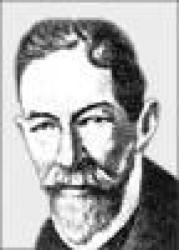
Adolf fon Bayer
 Germany
Biography of Adolf von Baeyer
Adolf von Baeyer was a German chemist born in Berlin. He was the eldest of five children of Johann Jacob Baeyer and Eugenie (Hitzig) Baeyer. His father was a Prussian army officer and author of published works on geography and atmospheric refraction, while his mother was the daughter of renowned lawyer and historian Julius Eduard Hitzig. Baeyer showed an early interest in chemistry, and at the age of 12, he made his first chemical discovery, a new double salt called copper sodium carbonate.
After graduating from Friedrich Wilhelm Gymnasium, Baeyer entered the University of Berlin in 1853, where he studied mathematics and physics for the next two years. Following a year of military service, Baeyer became a student at Heidelberg University and began studying chemistry under the guidance of Robert Bunsen, who had recently invented the Bunsen burner and named it in his honor. In Heidelberg, Baeyer focused his attention on physical chemistry. However, after publishing an article on chloromethane in 1857, he became so fascinated with organic chemistry that he started working with Friedrich August Kekulé, a prominent figure in the field of structural chemistry, in his laboratory in Heidelberg.
In Heidelberg, Baeyer conducted research on organic compounds of arsenic, for which he was awarded a doctoral degree. From 1858 to 1860, he worked together with Kekulé at Ghent University in Belgium before returning to Berlin, where he lectured on chemistry at the Royal Technical College.
Under Kekulé's influence and his own passion for the structure of organic compounds, Baeyer initially studied uric acid and, starting from 1865, the structural composition of indigo, a highly valued blue dye. In 1866, Baeyer succeeded in isolating isatin, a water-soluble crystalline compound, through a new technique of reducing indigo using finely powdered zinc. This method allowed for a more in-depth structural analysis than the oxidation process conducted by August Laurent. In 1870, Baeyer became the first person to synthesize indigo, thus enabling its industrial production, by reversing the process of oxidizing isatin.
After moving to Strasbourg in 1872 and taking up the position of a chemistry professor at the University of Strasbourg, Baeyer focused on studying condensation reactions that released water. In the course of these reactions, he and his colleagues succeeded in identifying several important dyeing substances, including eosin pigments, which he later synthesized.
In 1875, following the death of Justus von Liebig, Baeyer became his successor and took the position of a chemistry professor at the University of Munich. For over four decades, he was a center of attraction for numerous talented students, with over 50 of them later becoming university professors themselves. Returning to the study of the precise chemical structure of indigo, Baeyer announced his research results in 1883, proposing a model in which the compound consists of two interconnected "rod-like" molecules (which he named indole). This model remained unchanged for 40 years until a more advanced technology emerged.
Baeyer's investigations into dyes led him to study benzene, a hydrocarbon in which six carbon atoms form a ring. At the time, there were competing theories regarding the nature of the carbon-carbon bonds and the arrangement of hydrogen atoms inside the molecular ring. Baeyer, more inclined towards experimental chemistry, rejected the existing theories and put forward his own theory of "strain." According to this theory, the presence of other atoms in a molecule causes the carbon-carbon bonds to be under strain, which determines both the shape of the molecule and its stability. Although this theory has been refined over time, Baeyer's original concept remains unchanged. His research on benzene also led him to understand that the molecular structure of the benzene ring in aromatic compounds, called hydro-aromatics, is a compromise between a cyclic formation and the structure of aliphatic hydrocarbons (without a ring). This discovery not only indicated the relationship between these three types of molecules but also opened up new possibilities for their study.
In 1885, on the day of Baeyer's 50th anniversary, he was granted a hereditary title in recognition of his contributions to Germany. In 1905, Baeyer was awarded the Nobel Prize in Chemistry "for his contributions to the advancement of organic chemistry and the chemical industry through his work on organic dyes and hydro-aromatic compounds." Due to illness, Baeyer was unable to attend the Nobel Prize ceremony and did not deliver his Nobel Lecture. However, in a 1900 article on the history of indigo synthesis, he expressed his joy at finally possessing the main substance for indigo synthesis and compared it to the satisfaction Emil Fischer must have felt when he synthesized purine, the starting material for uric acid, after 15 years of work.
As a Nobel laureate, Baeyer continued his research on molecular structure. His work on oxygen compounds led to discoveries regarding the tetravalence and basicity of oxygen. He also explored the relationship between molecular structure and optical properties, particularly color. In 1868, Baeyer married Adelheide Bendemann, and they had a daughter and two sons. He remained actively engaged in research until his retirement. Baeyer was highly respected for his experimental skills and inquisitive mind. Despite receiving numerous lucrative offers from chemical firms, he refused to apply his discoveries for industrial purposes and did not receive any income from his work.
Baeyer passed away on August 20, 1917, at his country house near Lake Starnberg, close to Munich. Among the honors Baeyer received was the Davy Medal awarded by the Royal Society in London. He was a member of the Berlin Academy of Sciences and the German Chemical Society.