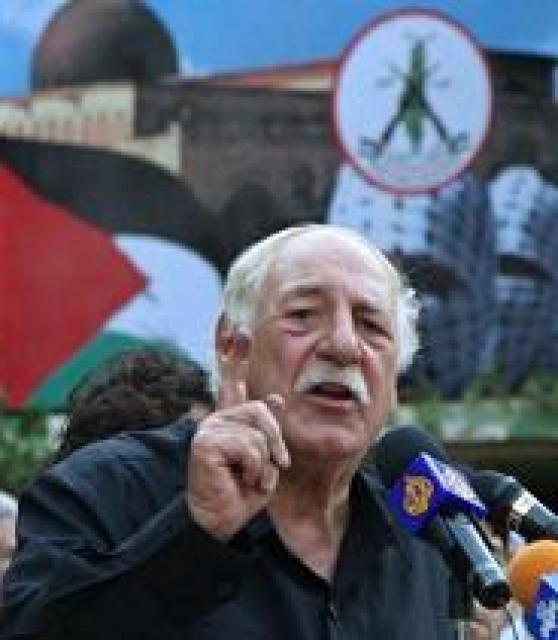
Ahmed Jibril
Ahmed Jibril was a Palestinian militant and political leader who founded and led the Popular Front for the Liberation of Palestine–General Command (PFLP-GC), a faction that became closely aligned with Syria. His decades-long career combined armed struggle, regional alliances and opposition to negotiations with Israel. Accounts differ on his exact birth year and birthplace; Palestinian reference sources commonly place his birth in Ramleh in 1935.
From Military Service to a New Faction
Jibril’s family moved to Syria after the 1948 Arab-Israeli war. He later served in the Syrian army, reaching the rank of captain and specializing in explosives, according to a Library of Congress research profile. In 1959, he formed the Palestine Liberation Front, an organization that pursued armed operations against Israel. He joined the Popular Front for the Liberation of Palestine (PFLP) after its formation in 1967, but soon broke away amid disagreements over its direction and leadership.
In October 1968, Jibril established the PFLP-General Command, commonly known as the PFLP-GC. The group maintained close ties with the Syrian government and emphasized military operations. It carried out attacks in the Middle East and Europe, including raids and bombings that killed civilians as well as soldiers. One of its best-known operations was a 1987 attack in which fighters used motorized hang gliders to cross from Lebanon into Israel, killing six Israeli soldiers. The group also fought in Lebanon’s civil war and later supported Syrian government forces during Syria’s own conflict, a position that drew criticism from many Palestinians.
The 1985 Prisoner Exchange
Jibril rejected the 1993 Oslo agreements and was a prominent opponent of the PLO leadership’s negotiations with Israel. His name became especially associated with the 1985 prisoner exchange between Israel and the PFLP-GC. Under the agreement, three Israeli soldiers held by the group were exchanged for 1,150 Palestinian and other prisoners held by Israel. Known as the Jibril Agreement, it became one of the largest exchanges of its kind and a major source of political recognition for him among Palestinians.
Jibril’s strategy depended on his organization’s military capacity and its alliances with regional states, particularly Syria. While presenting armed action as a means of advancing Palestinian national aims, he remained a divisive figure: his group’s attacks, its close relationship with Damascus and his rejection of negotiated settlements placed him at odds with Palestinian leaders who pursued diplomacy.
Later Years and Death
Jibril spent much of his later life in Damascus, where he continued to lead the PFLP-GC. During the Syrian uprising and ensuing civil war, the group sided with President Bashar al-Assad’s government. Jibril died in a Damascus hospital on 7 July 2021. He left behind an organization shaped by his personal leadership and a legacy closely tied to both Palestinian armed politics and Syria’s regional influence.





