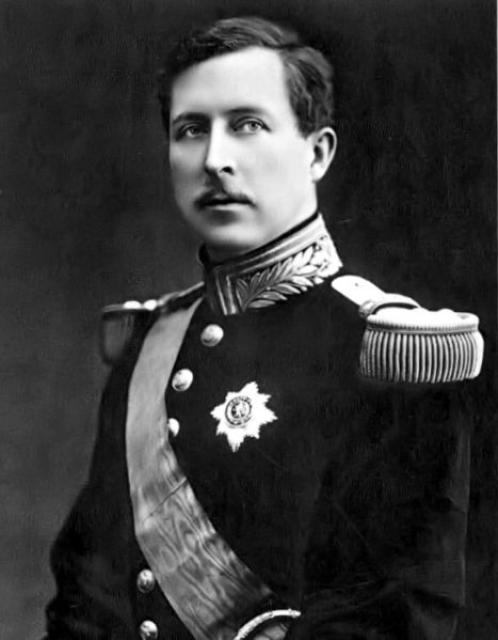
Albert I
 Belgium
Biography of Albert I
Albert I was the King of Belgians from December 17, 1909. He belonged to the Saxe-Coburg-Gotha dynasty. After the death of his elder brother Boduen in 1891, Albert was declared the heir to the throne. He received a private education and graduated from the Royal Military School in 1892. Prior to ascending the throne, he held the title of Count of Flanders. On October 2, 1900, he married Duchess Elisabeth of Bavaria, the daughter of Duke Karl Friedrich.
Albert I was the son of Count Philippe of Flanders and Princess Marie of Hohenzollern-Sigmaringen. He was the nephew of Belgian King Leopold II. Unlike his uncle, Albert was very popular as a monarch from the beginning of his reign. He avoided extravagance at the court, enjoyed hosting guests, and traveled extensively. In 1898 and 1919, he visited the United States. In 1900, he embarked on a trip to the "Free State of Congo" (his uncle King Leopold II's personal possession and "concession") and upon his return to Belgium, he insisted on changing the relationship with the Africans. As king, he significantly humanized the administration of the colony, turning it into a state-owned territory rather than a private possession.
Reforms and Contributions during World War I
In the years 1909-1910, significant reforms took place in Belgium. The compulsory military service law was adopted, as well as the law on education, which extended the duration of schooling to 14 years. Albert I gained the greatest fame and popularity in Europe (the Allied countries) during World War I. He learned about Germany's plans to start the war in 1913 from Wilhelm II in Berlin. The king warned France about the impending war. Shortly after the assassination of Archduke Franz Ferdinand in Sarajevo, on July 3, 1914, Albert informed Wilhelm II in a personal letter about the neutrality of his country. However, German troops violated Belgium's neutrality and invaded its territory. According to the 68th article of the Constitution, Albert became the commander-in-chief of the Belgian army. General Saller de Moranville served as the chief of staff.
Despite the enemy's overwhelming advantage, the Belgians had to retreat and abandon Brussels. However, Albert managed to reorganize his army and flood the low-lying banks of the Yser River by opening the dam gates (advice given by French General Ferdinand Foch). Throughout the war, the Belgians, led by their king, held a small foothold on their territory, despite the unequal forces. The fame of the "soldier king" and the "knight king" was enormous in all the Allied countries, including Russia. English writers and poets published a book called "The Book of King Albert," dedicated to the king and the people of Belgium. This book was soon translated into Russian. After the war, Albert continued to be regarded as a national hero. He contributed to the restoration of the country, which had suffered from German occupation during World War I. He supported the development of industry and the merchant fleet. He was appointed Field Marshal of the British Army in 1921.
Personal Life and Tragic Death
Albert had a passion for sports, horseback riding, mountaineering, and natural sciences. He read works in various fields daily, including literature, military affairs, medicine, and aviation. He rode motorcycles and learned how to pilot an airplane. Being an avid mountaineer, the king spent a lot of time in the mountains. Unfortunately, he met with a tragic accident and fell from a cliff, resulting in his death at the age of 59. On October 2, 1900, he married Elisabeth of Bavaria. They had three children: Leopold III, who later became the King of Belgium, Carl, the Duke of Flanders and Regent of Belgium, and Princess Marie José.





