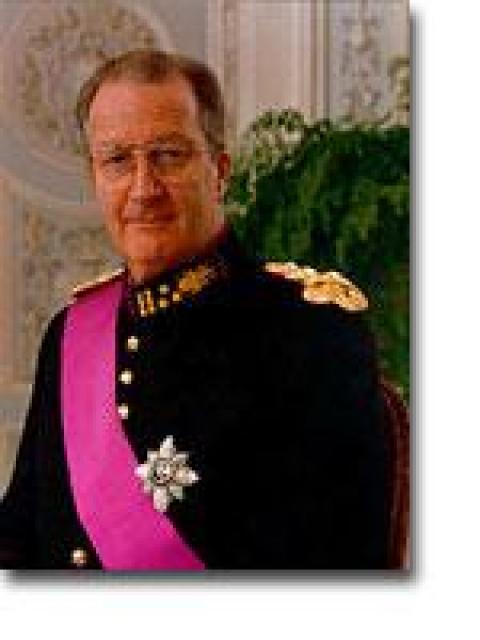
Albert II
 Belgium
Biography of Albert II, King of Belgium
Albert II, born on June 6, 1934, in Brussels, Belgium, is the King of Belgium since 1993. He was given the title of Prince of Liège at birth and is the son of King Leopold III and Queen Astrid, born Princess of Sweden. He is the great-grandson of King Albert I and Queen Elisabeth.
Early Life
Prince Albert, born in the Chateau du Stuyvenberg, spent his early years in Belgium. However, his life took a tragic turn on August 29, 1935, when his mother, Queen Astrid, died in a car accident in Küssnacht, Switzerland. Subsequently, during the German occupation of Belgium in May 1940, Prince Albert, accompanied by his older sister Princess Joséphine-Charlotte and older brother Prince Baudouin, fled first to France and then to Spain. They were later required to return to Belgium by the German government on August 2, 1940. The princes continued their education in the royal castle in the Ardennes until 1944.
In June 1944, when the Allied invasion of Normandy took place, King Leopold III, Princess Lilian (Leopold III's wife since 1941), and the royal children were exiled to Germany and later to Strobl in Austria, where they were liberated by the American army on May 7, 1945. Due to the political situation in Belgium, King Leopold III and his family were unable to return immediately and settled in Switzerland until July 1950. Meanwhile, Prince Albert continued his education at a college in Geneva.
Prince Albert's Career
Upon the return of King Leopold III to Belgium on July 22, 1950, accompanied by Prince Baudouin and Prince Albert, a series of significant events unfolded. King Leopold III decided to abdicate in favor of Prince Baudouin, who became King Baudouin I. On July 2, 1959, Prince Albert married Donna Paola Ruffo di Calabria, an Italian princess related to the Italian royal family. They have three children: Prince Philippe, born on April 15, 1960, Princess Astrid, born on June 5, 1962, and Prince Laurent, born on October 19, 1963.
In 1962, Prince Albert was elected Honorary President of the Belgian Foreign Trade Office. During his 31 years in this position, he chaired nearly a hundred economic missions worldwide and visited numerous Belgian companies involved in exports. In 1984, Prince Albert established a foundation for training foreign trade specialists. Additionally, he serves as the President of the General Commission of the General Savings and Retirement Bank (since 1954) and the President of the Belgian Red Cross (since 1958). In addition to fulfilling these various roles, Prince Albert has been involved in projects related to urban planning, rural preservation, landmarks, and monuments. In 1969, he was invited by the Council of Europe to serve as the President of the Conference of European Ministers responsible for the Protection of Cultural and Architectural Heritage.
Reign as King Albert II
In 1993, Prince Albert's brother, King Baudouin I, passed away. On August 9, 1993, Prince Albert took the oath before the Belgian Parliament and became the sixth King of the Belgians. Signing the new constitution on February 17, 1994, King Albert made a visit to the Parliament. He also participated in various events organized for the occasion of new elections.
In his daily audiences at the palace, King Albert meets with representatives from the political, economic, social, cultural, and sporting life of the country. Each year, the King receives more than twenty heads of state and representatives of international organizations. His participation in over a hundred events held throughout the country allows him to stay in touch with the concerns of the Belgian population. However, some areas of the King's activities hold special interest for him, such as unemployment, education, and social security issues. Additionally, King Albert closely monitors private and public projects aimed at addressing these problems.
As the Commander-in-Chief of the Belgian Armed Forces, King Albert II holds the rank of Lieutenant General and Vice Admiral. He actively participates in the development and reform of the armed forces' structure and makes decisions regarding Belgium's military activities at national and international levels.
In his capacity as King, Albert II has made official visits to Luxembourg in March 1994, Sweden in May 1994, Spain in September 1994, Denmark in May 1995, Germany in July 1995, Finland in June 1996, and Japan in October 1996.