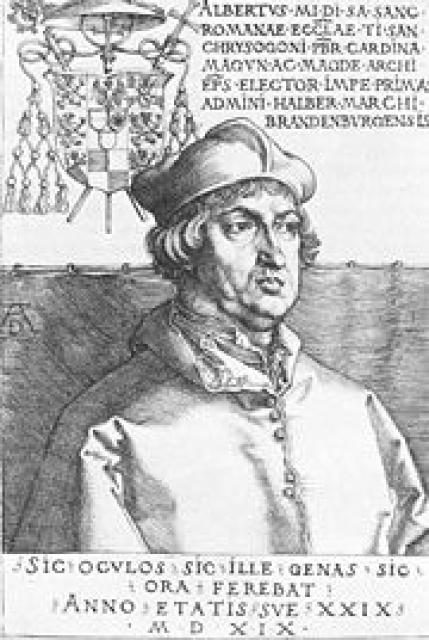
Albreht Brandenbugrskiy
 Germany
- Archbishop and Elector of Mainz
- Early Life and Career
- Archbishop of Mainz
- Indulgences and the Reformation
- Political Maneuvers
- Patron of the Arts and Architecture
- Personal Life
- Legacy
Archbishop and Elector of Mainz
Albrecht von Brandenburg (June 28, 1490 – September 24, 1545), also known as Cardinal Albrecht of Brandenburg, was a multi-faceted and influential figure in 16th-century Germany. As Archbishop of Mainz, he wielded considerable power within the Holy Roman Empire.
Early Life and Career
Albrecht was the youngest son of Elector Johann Cicero of Brandenburg and Margaret of Saxony. In 1506, he co-founded the University of Frankfurt an der Oder, where he studied theology. In 1513, he became Archbishop of Magdeburg and Administrator of the Diocese of Halberstadt.
Archbishop of Mainz
In 1514, Albrecht was elected Archbishop of Mainz and subsequently became one of the seven prince-electors of the Holy Roman Empire. In 1518, he was elevated to the rank of cardinal, despite the Catholic Church's prohibition against holding multiple ecclesiastical offices. He established his residence at Moritzburg Castle in Halle.
Indulgences and the Reformation
In 1517, Albrecht conducted the papal sale of indulgences, a practice that provoked Martin Luther to publish his "Ninety-Five Theses," sparking the Protestant Reformation. Despite initially embracing humanist ideals, Albrecht later became an opponent of the Reformation, attempting to mediate a compromise but ultimately failing to prevent the split in the Church.
Political Maneuvers
Albrecht played a role in European politics, calling for peace and unity against the Ottoman threat. He mediated between Protestant princes and the Catholic emperor, Ferdinand I, but also supported the emperor's use of force against Protestants. In 1540, he became the first German prince to welcome Jesuits into his territory.
Patron of the Arts and Architecture
Albrecht was a great patron of the arts and architecture. He commissioned Lucas Cranach the Elder to paint 16 altars for Halle Cathedral, a massive project that remains one of the most significant art commissions in German history. He also commissioned works from Matthias Grünewald, Hans Baldung, and Albrecht Dürer. His patronage helped establish Halle as a major center of Renaissance culture.
Personal Life
Albrecht had several lovers, including Elizabeth "Leis" Schütz and Agnes Pless. He fathered a daughter, Anna, by Leis. He also had a close relationship with his godson, Moritz of Saxony, who was raised in Albrecht's court.
Legacy
Albrecht's legacy is complex and controversial. He was both a promoter of religious reform and an opponent of the Protestant movement. He enriched the art and architecture of Halle but also profited from the sale of indulgences. Despite his flaws, he remains remembered as a significant figure in German history and a patron of the arts who left a lasting imprint on his time.


