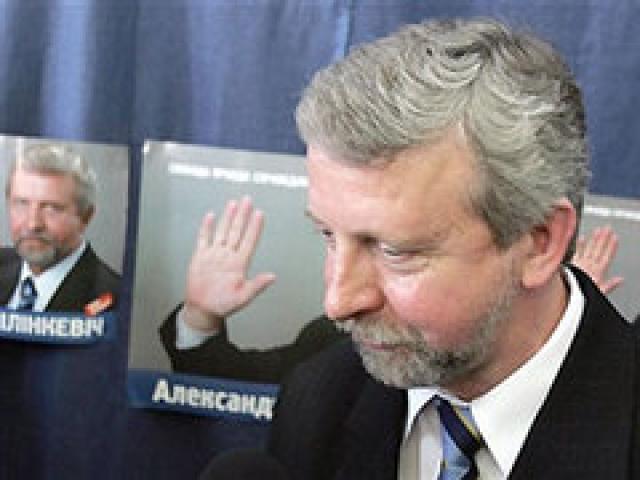
Aleksandr Milinkevich
 Belarus
- Early Life and Education
- Academic Career
- Political and Civic Engagement
- Presidential Bid and Aftermath
- Scholarly and Cultural Contributions
Early Life and Education
Alexander Milinkevich was born on July 25, 1947, in Grodno, Belarus, to a distinguished family. Both his great-grandfathers participated in the Polish-Belarusian uprising of 1863-1864 and faced repression from Russian authorities. His grandfather was an activist in the Belarusian movement during the 1920s.
In 1969, Milinkevich graduated from the Faculty of Physics and Mathematics at the Grodno Pedagogical Institute. He initially worked as a school teacher in Grodno and later pursued graduate studies at the Institute of Physics of the Belarusian Academy of Sciences (1972).
Academic Career
Milinkevich received his doctorate in 1976 after completing a dissertation on the "Mechanism of Generation of Super-Powerful Laser Pulses." He returned to Grodno, where he worked as an engineer and lecturer at the Grodno State University from 1978 to 2000.
From 1980 to 1984, Milinkevich headed the Department of Physics at the University of Setif in Algeria. Subsequently, he pursued international research and training at the University of Montpellier in France, the University of California in the United States, and various European Union institutions.
Political and Civic Engagement
Milinkevich's entry into politics emerged in 2001 as the campaign manager for presidential candidate Syarhei Da mash. When Da mash withdrew, Milinkevich returned to civic activism.
In 1990, Milinkevich served as Deputy Chairman of the Grodno City Executive Committee overseeing various aspects of civic life, including education, healthcare, youth development, and international relations. From 1996 to 2003, he led the Grodno public association "Rat us ha," which was subsequently liquidated by the authorities.
Presidential Bid and Aftermath
In October 2005, Milinkevich was selected as the joint opposition candidate for the 2006 presidential election. He campaigned on a platform of European integration and democratization.
Despite his defeat in the election, receiving only 6 percent of the vote, Milinkevich urged the opposition to mobilize in protest. A series of demonstrations ensued, eventually culminating in a dispersal by police.
Despite the setback, Milinkevich vowed to continue peaceful resistance against President Alexander Lukashenko. He acknowledged that an "orange revolution" similar to those in neighboring countries would not materialize in Belarus at the time.
Scholarly and Cultural Contributions
Beyond his political endeavors, Milinkevich is a prominent scholar and cultural figure. He has authored numerous scientific publications in quantum electronics and laser technology. Additionally, he has written extensively on Belarusian history, culture, education, and architecture.
Milinkevich is a polyglot, fluent in Belarusian, English, French, Polish, and Russian. He was an instrumental figure in locating and researching the burial site of Stanisław August Poniatowski, the last King of the Polish-Lithuanian Commonwealth.
Milinkevich holds the Order of Merit for Polish Culture and the International Prize of the Independent Foundation "PolCul" (Australia). He is married with two sons and a granddaughter.


