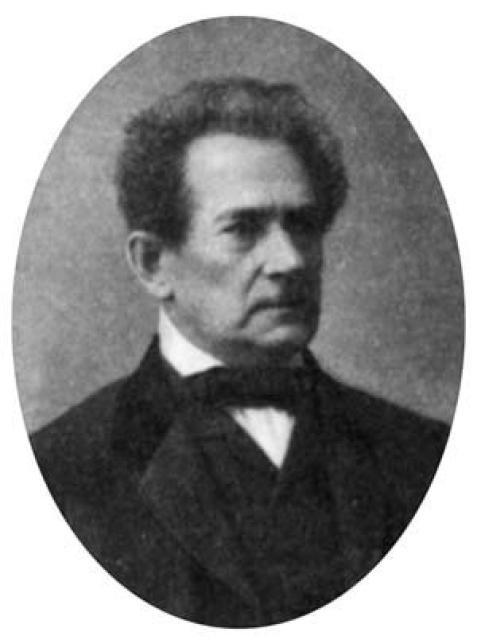
Aleksandr Nikitenko
 Russia
Early Life and Education
Aleksandr Vasilyevich Nikitenko, a renowned memoirist and literary critic, was born in 1804 or 1805 to a serf father who worked for Count Sheremetev. Despite being educated beyond his peers, Nikitenko's father was subjected to persecution due to his servitude. This difficult environment shaped Nikitenko's childhood.
Nikitenko received his initial education at the Voronezh County School, but was denied access to secondary education due to his status as a serf. In 1822, he became the secretary of the Ostrogozhsk branch of the "Biblical Society." His remarkable speech at a gathering in 1824 caught the attention of Prince A.N. Golitsyn, the society's president.
Through the intervention of Vasily Zhukovsky and others, Nikitenko gained his freedom in 1825. He enrolled in Saint Petersburg University, narrowly escaping execution after being implicated in the Decembrist Rebellion. Nikitenko graduated from the Faculty of History and Philosophy, publishing his first article, "On Overcoming Misfortunes" in 1826.
Career as Professor and Censor
Following his graduation, Nikitenko was employed as a secretary to K.M. Borozdin, the trustee of the educational district. He also annotated the new censorship statute of 1828 on Borozdin's request. After unsuccessful attempts to secure a teaching position in law and political economy, Nikitenko became an adjunct and later a professor in Russian literature.
In 1833, Nikitenko was appointed censor, serving for eight days of confinement for allowing the publication of Victor Hugo's poem "Enfant, si j'etais roi." He continued to teach Russian literature, serving as an editor for the journal "Son of the Fatherland" from 1839 to 1841. He also received a doctorate in philosophy for his dissertation on poetic creativity and genius.
Nikitenko became a member of the Academy of Sciences in 1853. He drafted and annotated censorship statutes in a relatively liberal spirit. In 1842, he was briefly detained for allowing the publication of a satirical story about courier drivers.
Later Years and Legacy
Nikitenko embraced the era of Russian reforms, describing himself as a "moderate progressive." He joined a secret committee on censorship in 1859 and advocated for the creation of an independent censorship body under the Ministry of Education. The transfer of censorship authority to the Ministry of Internal Affairs came as an unexpected blow to him.
Nikitenko also served as the editor of the "Contemporary" from 1847 to 1848 and the "Journal of the Ministry of Public Education" in the 1850s. He was also a member and later the chairman of the Theatre Committee.
Nikitenko died on July 21, 1877. As a critic, professor, and literary historian, his contributions were limited. However, his "Speech on Criticism" and "Introduction to the History of Russian Literature" are noteworthy for their ambiguity.
The "My Tale" Diary
Nikitenko's most significant legacy is his diary, "My Tale of Myself and What I Have Witnessed in Life," which was published posthumously. It is a rich cultural-historical source, particularly for the history of Russian censorship. The diary reveals Nikitenko's contradictions: a thinker and patriot, yet also an opportunist who justified his accommodation with authority. Despite his struggles with serfdom and the pressures of censorship, Nikitenko's diary remains a valuable "human document."


