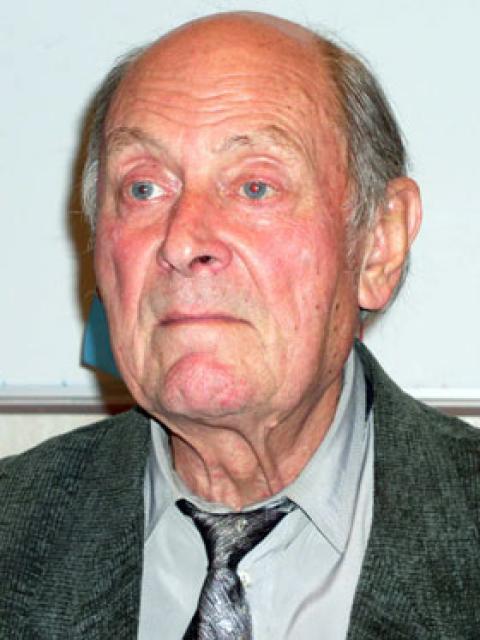
Alemdar Karamanov
 Ukraine
- Early Life and Career
- Moscow Conservatory and Musical Vanguard
- Return to Simferopol and Religious Influences
- Prolific Compositions and International Recognition
- Crimean Inspirations and Legacy
- Awards and Recognition
- Memorial and International Legacy
Early Life and Career
Alemder Sabitovich Karaman was born on September 10, 1934, in Simferopol, Ukraine. Despite being of Turkish descent, Karaman identified as Ukrainian and displayed exceptional musical talent from a young age, composing his first pieces at just five years old.
Moscow Conservatory and Musical Vanguard
In 1953, Karaman was admitted to the prestigious Moscow State Conservatory named after P. I. Tchaikovsky. He studied composition under S. S. Bogatyrev and piano under V. A. Natanson, later becoming a postgraduate student under Dmitry Kabalevsky and Tikhon Khrennikov.
During his Moscow years, Karaman gained recognition for his prolific and multifaceted works. Notable pieces from this period include the 7th Symphony "Lunar Sea," the dramatization "Lenin," Piano Concertos Nos. 1 and 2, "Oriental Capriccio" for violin and orchestra, and the Second String Quartet. His compositions were frequently performed in renowned venues such as the Bolshoi Theater in Moscow and the Mariinsky Theater in Leningrad.
Return to Simferopol and Religious Influences
In the early 1960s, Karaman developed a keen interest in musical avant-garde and became a leading figure in this movement alongside composers like Alfred Schnittke. However, his avant-garde phase was short-lived, lasting from 1962 to July 1964.
Following a spiritual awakening, Karaman returned to his hometown of Simferopol and dedicated himself to religious-themed music. He explored Christian and Orthodox influences in works such as the symphony cycle "Sovershisha," (1965-1966), Stabat Mater (1967), and Requiem (1971).
Prolific Compositions and International Recognition
In the 1970s, Karaman continued to compose prolifically, producing another symphony cycle, "Et in Amorem Vivificantem" (1970s), the 17th Symphony "America" (1970s), and the significant six-symphony cycle "Byst" (1970s) based on the Revelation of John.
Despite his relative isolation in Simferopol, Karaman's music gained international recognition in the 1990s thanks to his agent Kasevin Rodell. In 1995, he made his debut in London, where his Third Piano Concerto "Ave Maria" and "Stabat Mater" were performed to critical acclaim.
Crimean Inspirations and Legacy
Karaman's later works often drew inspiration from his Crimean roots. Notable pieces include the oratorio "Legend-Fact Adzhimushkay" (1983) and the 24th Symphony "Adzhimushkay" (1983), as well as the Mystery "Chersonesos" (1994) commemorating the 2500th anniversary of the ancient city.
Karaman's music was performed by renowned conductors such as Vladimir Ashkenazy and Vladimir Fedoseev. His works continue to be performed and recorded worldwide, including a recent complete symphony cycle recording by the Czech Philharmonic Orchestra.
Awards and Recognition
Throughout his career, Karaman received numerous awards and accolades, including the title of People's Artist of Ukraine, the Taras Shevchenko National Prize of Ukraine (2000), and membership in the Academy of Arts of Ukraine. He was also a laureate of the State Prize of Crimea and an honorary citizen of Crimea.
Memorial and International Legacy
Alemder Karaman passed away on May 3, 2007, in Simferopol. The International Competition of Young Pianists named after Alemder Karaman was established in Crimea in 1996. The competition promotes his music and supports young musicians from around the world.
Karaman's music has been the subject of numerous dissertations and scholarly works. His legacy as an influential composer and a pioneer of religious-themed music continues to inspire and resonate with audiences worldwide.


