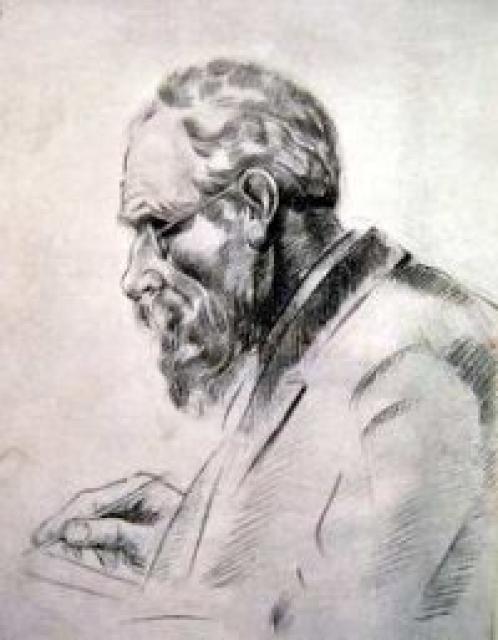
Alexander Buchkuri
Alexander Alexeevich Buchkuri
Early Life and EducationBorn in Taganrog, Russia, Alexander Buchkuri's father was a Greek merchant of Turkish citizenship. Raised by his stepfather, A.I. Mikhelson, Buchkuri's artistic aspirations were encouraged from an early age.
He studied at the Voronezh Free Drawing School (1893-97) and the St. Petersburg School of M.K. Tenisheva (1898-99). In 1904, he graduated from the St. Petersburg Academy of Arts with a diploma work titled "The Death of Dmitry the Pretender."
Artistic Career
Influenced by Ilya Repin, Buchkuri returned to Voronezh in 1907. He taught at the Voronezh Free Drawing School (1909) and played a key role in establishing the Voronezh branch of the Association of Artists of Revolutionary Russia and the Society of Wanderers.
Organizer and Leader
In 1933, Buchkuri founded the Union of Artists of the Central Black Earth Region, uniting the artistic forces of Voronezh, Orel, and Kursk. He served on the union's governing board.
Tragic End
During the Nazi occupation of Voronezh in 1942, Alexander Buchkuri was killed by German forces. Witnesses reported that he was executed along with his wife near Karsnoarmeyskaya Street. Other accounts place his death in different locations.
Legacy
Buchkuri's talent was recognized by his mentor, Ilya Repin, who described him as "an excellent artist." A street in Voronezh bears his name.
Notable Works
Buchkuri's works include:"Peasant Women" (1902)
"Funeral" (1905)
"Laundress" (1908)
"Wedding Train" (1913)
"Self-Portrait with Family" (1915)
"Breakfast on the Hayfield" (1933)
"Teahouse" (1933)
"Circus" (1936)
"Amazons" (1937)
"Self-Portrait" (1941)


