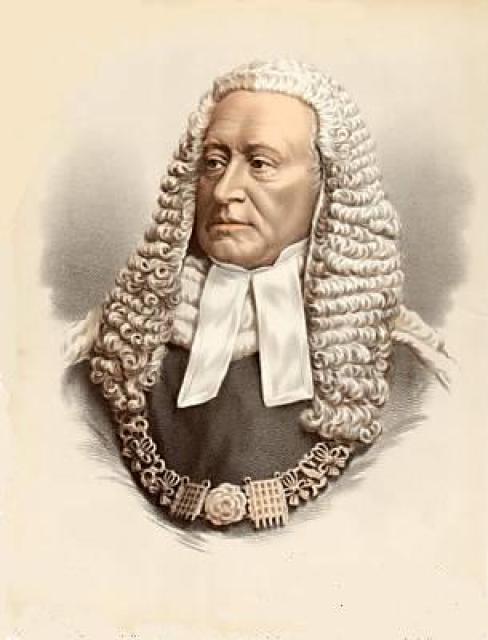
Alexander Cockburn
 Great Britain
- Biography of Alexander Cockburn
- Early Life and Education
- Political Career
- Judicial Career
- Legal Achievements
- Personal Life
Biography of Alexander Cockburn
Sir Alexander James Edmund Cockburn, 12th Baronet, was an English lawyer, politician, and judge. He was known for his playboy lifestyle and extravagant personality. As the Lord Chief Justice, he presided over some of the most famous legal cases of the 19th century.
Early Life and Education
Alexander Cockburn was born on September 24, 1802, in Alâna, Romania, which was then part of the Habsburg Monarchy. His father, Alexander Cockburn, was the fourth son of Sir James Cockburn, 8th Baronet, and was married to Yolande, the daughter of Viscount Vignier. Cockburn spent much of his early life abroad, becoming fluent in French and familiarizing himself with German, Italian, and Spanish. He received his education at Trinity Hall, Cambridge, where he graduated with a Bachelor of Laws in 1829. He later became an honorary fellow of the college. Cockburn began his legal career at Middle Temple, one of the Inns of Court, where he was called to the bar in 1829.
Political Career
In 1834, Cockburn was recommended by Edward Ellice to be a member of the commission investigating the state of corporations in England and Wales. His work in Parliament led him to become interested in politics, and he became the Recorder of Southampton. From this point on, he prioritized his public trial work over his parliamentary duties. In 1841, Cockburn became a Queen's Counsel, and in 1847, he successfully ran for Parliament as a Liberal. In 1850, he was appointed Solicitor General by Lord John Russell, and in 1851, he became Attorney General, a position he held until February 1852. Cockburn served as Attorney General once again under Lord Aberdeen's ministry until 1856.
Judicial Career
Cockburn's judicial career began in 1854 when he was appointed Recorder of Bristol. Two years later, he became the Chief Judge of the Court of Common Pleas. In 1858, he inherited the baronetcy. In 1859, Lord Campbell became the Lord Chancellor, and Cockburn took his place as the Chief Justice of the Court of Queen's Bench. Despite several prime ministers recommending him for a peerage, Queen Victoria refused, citing the "immorality of the Chief Justice." Cockburn continued working until his death, ignoring his doctor's orders, and died from a chest infection at his home on Hertford Street, London. He never married and had no legitimate children.
Legal Achievements
As a skilled advocate, Cockburn was involved in the high-profile case of Daniel M'Naghten, secretary to Sir Robert Peel, in 1843. Representing the defendant, Cockburn successfully argued for his client's insanity using the work of Isaac Ray on medical jurisprudence. He expanded the understanding of insanity in court, going beyond the traditional "inability to distinguish right from wrong" and exploring causation. Cockburn was an innovator in the use of forensic medicine in the courtroom.
As a judge, Cockburn actively sought out high-profile cases, likely to gain attention from the press. He presided over the civil case in which Arthur Orton claimed to be the missing baronet, Sir Roger Tichborne, a trial that lasted 103 days, making it the longest civil trial at the time. He also presided over the trial of Henry Wainwright for murder, a case that gained widespread attention before being overshadowed by the appearance of Jack the Ripper.
Personal Life
Cockburn was known for his small stature and noble appearance. He enjoyed yachting, participating in various sports, and writing. He was an adventurous man from a young age and had numerous love affairs. His promiscuous behavior resulted in two illegitimate children. Cockburn was known for his reckless actions, which often contradicted societal expectations. In one instance, he had to escape through a wardrobe window at Ruymont Castle in Exeter to avoid being caught by the estate manager during one of his love escapades. Another story recounts how Cockburn and fellow lawyer William Ballantine protested against police misconduct towards a woman on Sackville Street. They were arrested for obstructing a constable in the execution of his duty but were released after their acquaintance clarified their identities to the inspector.
Despite his controversial reputation, Cockburn was a passionate advocate for the fair and just practice of law. He believed that lawyers should defend their clients' interests lawfully, reconciling them with the principles of truth and justice. However, as a judge, Cockburn did not earn a high reputation among legal circles. It was often joked that he became a high-class judge simply by sitting next to Lord Blackburn. Judge Charles Francis Adams, Sr. regarded Cockburn's temperament as so unpredictable that he appeared mentally unstable.


