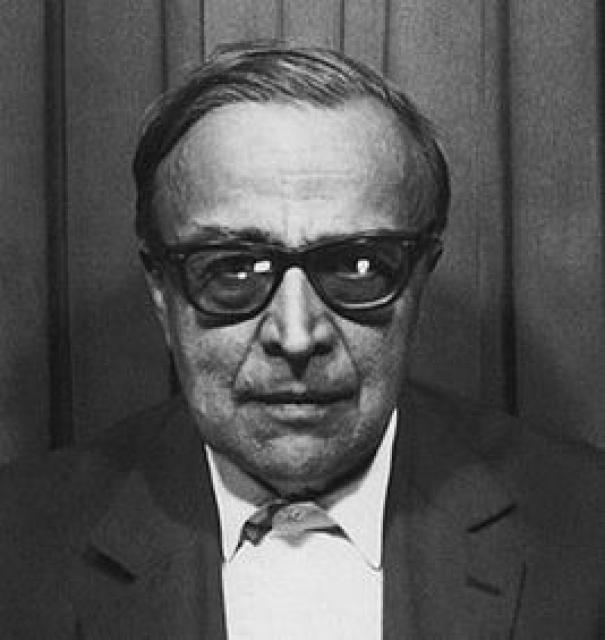
Alexander Kozhevnikov
 France
- Russian-Born French Philosopher in the Neo-Hegelian Tradition
- Early Life and Career
- Lectures on Hegel's "Phenomenology of Spirit"
- Influence and Reception
- Other Publications and Administrative Career
- Reaction to the Paris Riots of 1968
Russian-Born French Philosopher in the Neo-Hegelian Tradition
Alexander Kojève, a Russian-born French philosopher, was a prominent figure in the neo-Hegelian tradition.
Early Life and Career
Hailing from Moscow, Kojève was the nephew of abstract artist Wassily Kandinsky, with whom he maintained a correspondence and dedicated some of his scholarly inquiries. As a 15-year-old, Kojève initially welcomed the October Revolution, but he left Soviet Russia in 1920 following an incident with the Cheka.
Kojève pursued his studies in Germany at the University of Berlin and Heidelberg from 1921 to 1927. Under the guidance of existentialist thinker Karl Jaspers, he completed his doctoral dissertation on the Russian philosopher Vladimir Solovyov's views on the unity of Christ's divine and human nature. At the École Pratique des Hautes Études, Kojève encountered émigré historian of science Alexandre Koyré, who introduced him to Hegelianism.
Lectures on Hegel's "Phenomenology of Spirit"
Kojève permanently resided in France from 1927 (receiving citizenship in 1937) and Gallicized his name to Kojève. In the late 1920s, he befriended "Left" Eurasians, including Prince Svyatopolk-Mirsky and Lev Karsavin.
Kojève's famous lectures on Hegel's "Phenomenology of Spirit" (delivered in Paris from 1933 to 1939) attracted an illustrious audience of French and European intellectuals. Published in 1947 as "Introduction to the Reading of Hegel," they presented a brilliant exegesis of Hegelian philosophy, accompanied by independent treatises on the historical-dialectical method and the Hegelian concept of death.
Influence and Reception
Kojève's lectures attracted luminaries such as André Breton, Raymond Aron, Maurice Merleau-Ponty, Jacques Lacan, Georges Bataille, and Pierre Klossowski. His legacy influenced later French thinkers, including post-structuralists Michel Foucault and Jacques Derrida. Traces of his ideas can be discerned in French existentialism, phenomenology, surrealism, and postmodernism.
Despite the profound influence of Kojève's philosophical analysis, he remains relatively unknown outside academic circles. Critics include Louis Althusser.
Other Publications and Administrative Career
Beyond his lectures on Hegel's "Phenomenology of Spirit," Kojève published significant works, including a book on Immanuel Kant's philosophy and essays on the relationship between Hegelian and Marxist thought and Christianity. Several posthumous publications appeared after his death.
Kojève's academic reputation led to administrative recognition. He served as an advisor on trade negotiations and played a pivotal role in developing the European Common Market and the General Agreement on Tariffs and Trade. He was also a prominent advisor in the cabinet of Valéry Giscard d'Estaing.
Reaction to the Paris Riots of 1968
Unlike many left-wing French intellectuals, Kojève was dismissive of the student protests in Paris in the spring of 1968, calling them "the childish games of wealthy children." He maintained that true revolutions require sacrifices.
Kojève passed away on June 4, 1968, shortly after presiding over a meeting of the European Economic Community in Brussels.


