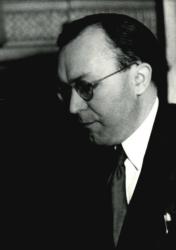
Alfred Jules Ayer
 Great Britain
- Early Life and Education
- Career and Influence
- Logical Positivism and the Verification Principle
- Rejection of Metaphysics and the Emotivist Theory
- Later Life and Legacy
- Continued Contributions and Impact
- Autobiography and Recognition
Early Life and Education
Alfred Jules Ayer(October 29, 1910 - June 27, 1989) was an English philosopher and a prominent figure in logical empiricism. Born in London, he received his education at Eton and Christ Church College, Oxford.
Career and Influence
Encounter with the Vienna CircleIn 1932, Ayer traveled to Vienna, where he became acquainted with the "Vienna Circle," a group of philosophers, scientists, and mathematicians who advocated for a "scientific worldview" in philosophy. Their central tenet was the "verification principle."
Logical Positivism and the Verification Principle
In his influential work "Language, Truth and Logic" (1936), Ayer proposed a version of the verification principle that stipulated that a proposition is meaningful only if it is either analytic (its meaning alone determines its truth or falsity) or if some conceivable experience "can serve to determine its truth or falsity" (i.e., it is an empirical hypothesis). He argued that metaphysical, theological, and ethical statements were literally meaningless and thus neither true nor false.
Rejection of Metaphysics and the Emotivist Theory
According to Ayer, metaphysical statements are the result of logical and linguistic errors. However, ethical, aesthetic, and certain religious judgments were deemed to have an "emotive" force, expressing the inner states of those who made them and thus falling within the realm of psychology.
Later Life and Legacy
Loss of Popularity and Analytic PhilosophyLogical positivism, despite its initial popularity, faced challenges in formulating the verification principle in a way that did not exclude meaningful scientific hypotheses. By the mid-1950s, it had lost favor, though its methods were adopted by analytic philosophy.
Continued Contributions and Impact
Throughout his career, Ayer continued to publish significant works, including "The Foundations of Empirical Knowledge" (1940), "The Problem of Knowledge" (1956), and "Russell and Moore: The Analytical Heritage" (1971). His writings are known for their clarity and precision, offering valuable analyses even to those who disagree with his verificationist approach.
Autobiography and Recognition
Ayer's autobiography, published in two volumes in 1977 and 1984, provides insights into his personal and intellectual journey. His contributions to philosophy earned him numerous honors, including election to the British Academy (1952), the title of Emeritus Professor (1959), and a knighthood (1970).