Anacreont
 Greece
Biography of Anacreon
Anacreon was an ancient Greek lyric poet who was included in the canonical list of the Nine Lyric Poets by scholars of Hellenistic Alexandria. Little is known about the origin and life of Anacreon. He was born in the city of Teos in Ionia. Sources mention four possible names for his father: Scyphian, Eumelus, Parthenius, and Aristocritus. Around 545 BCE, before the Persians conquered Teos, Anacreon managed to flee to Thrace with a group of fellow citizens. They later established a colony in Abdera, as the Greek cities of Asia Minor were soon captured by the famous Harpagus, one of the military commanders of Cyrus the Great. Before his exile, Anacreon presumably participated in military actions, in which he admitted that he did not distinguish himself. After some time, Anacreon received an invitation from the tyrant Polycrates of Samos, at whose court he stayed until 522 BCE. Anacreon mentions that he was a mentor to the tyrant, and Herodotus mentions that he had Polycrates' trust. In response to the favor and patronage, Anacreon dedicated a series of hymns to his patron.
After the death of Polycrates, Anacreon moved to Athens, to the court of the tyrant Hipparchus, son of Pisistratus. Hipparchus, who inherited his father's literary tastes, sent a special embassy to fetch Anacreon on a fifty-oared galley. In Athens, Anacreon met Simonides and other members of the brilliant poetic circle that gathered at Hipparchus' court. The time and place of Anacreon's death are unknown. When the society of writers disbanded after the murder of Hipparchus, Anacreon likely returned to his native Teos, where, according to an epitaph attributed to Simonides, he died and was buried. According to other accounts, before returning to Teos, Anacreon accompanied Simonides to Thessaly, to the court of Echecratides, king of the Thessalian dynasty of the Aleuadae.
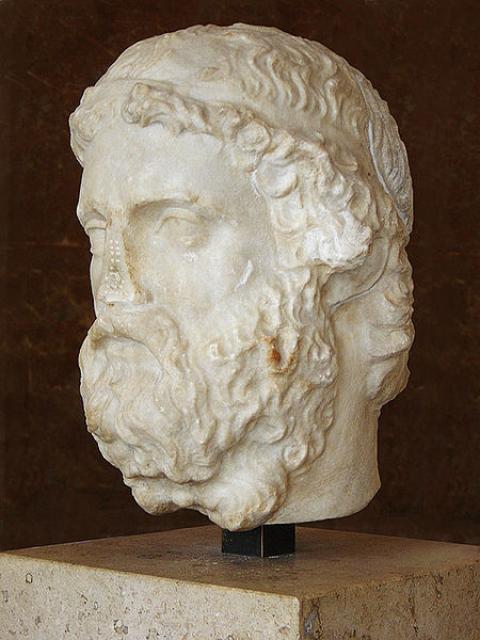
Lucian mentions Anacreon among the celebrated long-lived poets; according to him, Anacreon died at the age of 85. According to the story recounted by Pliny the Elder, Anacreon died after choking on a grape seed (this story seems anecdotal and unlikely to be taken seriously). Anacreon was highly popular in Athens; for example, a statue of Anacreon was placed on the Acropolis, next to the statue of his friend Xanthippus. On several coins from Teos, Anacreon is represented with a lyre in his hands, sometimes sitting, sometimes standing. In 1835, a statue believed to depict Anacreon was found in the Sabine Mountains in Italy and is now housed in the Borghese Gallery. Anacreon's poems, written in the Ionic dialect of the Greek language, were intended for solo singing or recitation accompanied by a musical instrument, likely the lyre, hence the term "Anacreontic" referring to his lyrics.
Athenaeus and the Suda mention five books of Anacreon's texts prepared in the Alexandrian school: three books of lyric poems, one of iambics, and one of elegies. Only insignificant fragments have survived to this day, collected from quotes by later authors. In addition to hymns and partheneia (choral songs performed by girls), Anacreon's lyrical compositions include love songs and poems lamenting the fleetingness of youth and the swift arrival of old age. Invective tones are present in the iambic compositions, with the most famous being the address to the "Thracian colt," which needs taming, and a malicious attack against a wealthy upstart named Artemon.
Anacreon is the inheritor of Alcaeus and Sappho, but the tone of his texts is more worldly and more mocking. Anacreon's concept is characterized by simplicity in perceiving the world, irony towards oneself, and a lack of deep feelings and passion. The main motifs are the measured, consciously cultivated enjoyment of life's pleasures: love, wine, banquets, freedom of thought; the emotional backdrop is the anticipation of death and the burdens of old age.
In an era of political and social upheavals, when Anacreon often witnessed the fall of one and the rise of another, the poet "valued light, fleeting joys, sought the present, despised the uncertainties of the future, and forgot the irretrievable past." Anacreon's cult of the present, however, is imbued with a spirit of moderation; orgiastic behavior is foreign to him. Wine is "diluted with water so that the song remains harmonious over the cup." Athenaeus notes that Anacreon "was sober when he wrote"; Anacreon himself (and later imitator Horace) firmly rejects the wild excesses of the Scythians. The poet extols the "love of the harmonious hymn, with a full cup."
Anacreon was also known as a composer of hymns. The most famous and considered the best are two short hymns to Artemis and Dionysus (preserved in eight and eleven lines respectively). Anacreon was not the "drunkard and libertine" that tradition often portrays him as. This reputation was created for the poet by numerous imitations in later periods, including some epigrams (in which, for example, he is attributed with "triple allegiance" to the muses, wine, and love) and a collection known as the "Anacreontea." Imitating Anacreon gave rise to the so-called Anacreontic poetry in late antiquity, the Renaissance, and the Enlightenment.
The "Anacreontea" survived in a manuscript from the 10th century and was published in 1554 in a Latin translation by Henri Estienne (nothing is known about the origin of the manuscript itself). The collection contains often very elegant poems in the style and spirit of Anacreon, but excessively emphasize the amorous or festive moment. The delicate freshness of the original is often replaced by a cloying (although at times undeniably charming) frivolity that is not characteristic of Anacreon himself. The collection was written in the Alexandrian (and partly later) period, when this genre was in vogue among the wealthy classes of major trading cities. This collection later created the fame of Anacreon and inspired numerous imitations in later literature.
Anacreon's great popularity in 17th-18th century Europe is primarily due to pseudo-Anacreontic poetry. The prevailing philosophy of Epicurus, widespread in Europe at that time, favored the development of contemporary Anacreontic poetry. In Russian literature, notable works within this tradition were created by G. R. Derzhavin, M. V. Lomonosov, K. N. Batiushkov, and A. S. Pushkin. In France, notable examples include É. Parny, A. Chénier, Voltaire, P. Béranger, and Chaulieu. In Italy, there is Luigi Vittorio Savioli; in Germany, Gleim, Gagedorn, and Lessing; in England, M. Prior, E. Waller, and J. Gay.