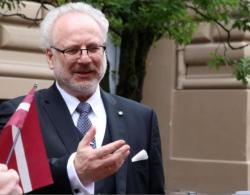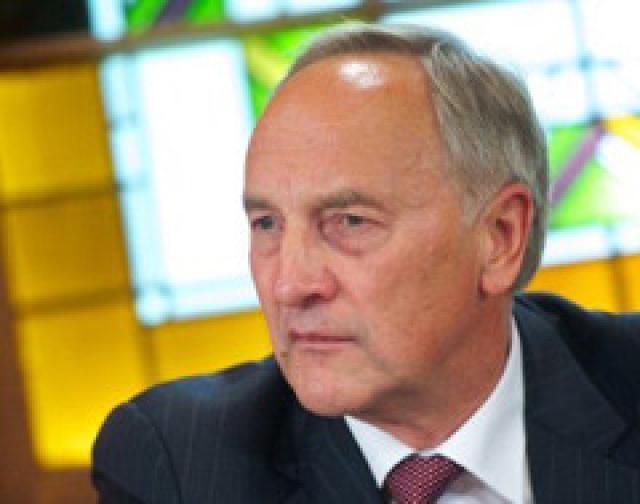
Andris Berzins
 Latvia
- Andris Bērziņš: A Journey from Engineer to President
- Political Beginnings
- Banking and Business Ventures
- Political Re-emergence
- Personal Life and Wealth
- Legacy
Andris Bērziņš: A Journey from Engineer to President
Early Life and CareerAndris Bērziņš was born on December 10, 1944, in the village of Nītaure, Latvia. He completed his primary education in 1958 and continued to pursue his secondary studies at the Sigulda First High School until 1962. Bērziņš served three years in the Soviet Army before enrolling at the Riga Polytechnic Institute in 1970. He graduated in 1971 with a degree in radio engineering.
Bērziņš began his engineering career at the "Elektrons" enterprise, which specialized in radio equipment repair. He steadily rose through the ranks, eventually becoming the company's director. During his tenure, Bērziņš joined the Communist Party of the Soviet Union, citing it as a career advancement move.
Political Beginnings
In 1988, Bērziņš obtained a second degree in economics from the Faculty of Economics at the University of Latvia. That same year, he was appointed Deputy Minister of Consumer Services for the Latvian SSR. From 1989 to 1993, he served as Chairman of the Executive Committee of the Council of People's Deputies of Valmiera District.
Bērziņš's political career was marked by a shift from Communism to pro-independence. In 1990, he was elected to the Supreme Council of the Latvian SSR from the Popular Front of Latvia, a movement advocating for the republic's independence. He subsequently resigned from the Communist Party. Notably, Bērziņš voted in favor of the Declaration of Independence from the USSR on May 4, 1990. Latvia gained internationally recognized independence in August 1991.
Banking and Business Ventures
After the restoration of Latvian independence, Bērziņš took on various roles in the banking industry. In 1993, he became head of the Privatization Department of the Bank of Latvia and played a pivotal role in the creation of Latvijas Universala banka (Unibanka) from 21 branches of the Bank of Latvia. Bērziņš became Unibanka's President, with the government retaining a majority stake.
Unibanka soon became the largest bank in Latvia, but it faced financial challenges due to investments in Russian government bonds that defaulted in 1998. To stabilize the situation, shares in Unibanka were sold to Skandinaviska Enskilda Banken (SEB), and by 2000, Unibanka became a subsidiary of SEB. Bērziņš remained involved as an advisor to SEB and Honorary Member of the Unibanka Board.
In addition to banking, Bērziņš acquired a significant stake in Lode, a major Latvian building materials supplier. He sold his shares in 2007 for 4.53 million lats.
Political Re-emergence
Bērziņš's involvement in politics resumed in 2004 when he was elected to the Latvian Parliament on the Union of Greens and Farmers (ZZS) list. He remained a non-party member. During his tenure, he chaired Parliament's Economic Affairs Committee.
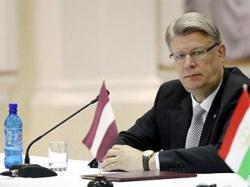
In May 2011, Bērziņš declared his candidacy for President of Latvia. He became an official candidate after being nominated by five ZZS deputies. On June 2, 2011, Bērziņš was elected President of Latvia in the second round of voting, defeating incumbent Valdis Zatlers. He was sworn into office on July 8, 2011.
Personal Life and Wealth
Bērziņš was known for his substantial personal wealth. He was included in the list of Latvian millionaires in 2008 and described as a multi-millionaire. His declared assets included numerous properties, businesses, investments, and a significant pension.
Bērziņš was married to his long-time partner, Dace Sejsūma, shortly before his inauguration. He had two sons and a daughter from his first marriage, as well as a son from his second marriage.
Legacy
Andris Bērziņš's presidency was marked by controversy and allegations of corruption. He was accused of nepotism and involvement in questionable business practices. However, he remained popular among some segments of the population, particularly in rural areas.
Bērziņš's legacy as President of Latvia remains a subject of debate, with some arguing that he represented the old guard of Latvian politics, while others view him as a pragmatic and experienced leader who contributed to the country's stability during a challenging economic period.