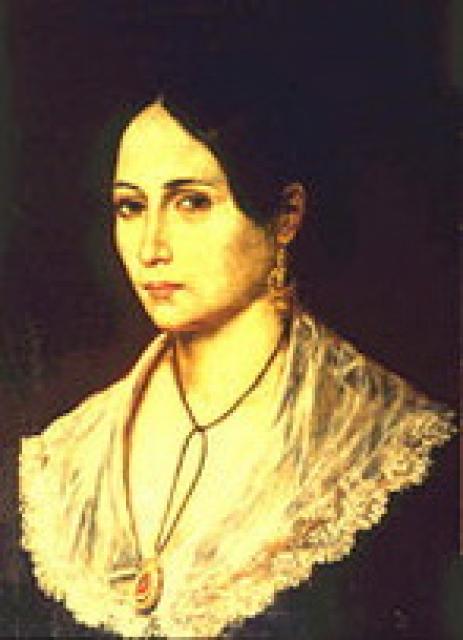
Anita Garibaldi
 Brazil
- Anita Garibaldi: A Brazilian-Italian Revolutionary
- Life with Giuseppe Garibaldi
- Death of Anita Garibaldi
- Children
Anita Garibaldi: A Brazilian-Italian Revolutionary
Anita Garibaldi, born Anna Maria "Anita" de Jesus Ribeiro, was a Brazilian-Italian revolutionary, wife, and comrade of Giuseppe Garibaldi. She was born into a poor family of Portuguese Azorean immigrants in the southern Brazilian state of Santa Catarina, a year before the country declared its independence from Portugal. Her parents were involved in cattle ranching and fishing.
Life with Giuseppe Garibaldi
Giuseppe Garibaldi fled to Brazil in 1836 and fought during the liberation war of the South American Republic of Rio Grande, better known as the Ragamuffin War. When the young Garibaldi first saw Anita, he could only whisper to her, "You must be mine." She joined Garibaldi on his ship, the "Rio Pardo," in October 1839. Within a month, she received her baptism of fire in the battles near Imbituba and Laguna, fighting on the side of her lover.
In 1841, the couple moved to the Uruguayan capital of Montevideo, where Giuseppe Garibaldi worked as a trader and teacher before taking command of the Uruguayan fleet in 1842 and forming the "Italian Legion" for the war against Argentine dictator Juan Manuel de Rosas. In 1847, Anita participated in the defense of Montevideo against the forces of former Uruguayan dictator Manuel Oribe and his Argentine ally Rosas. Anita and Giuseppe got married on March 26, 1842, in Montevideo.
Death of Anita Garibaldi
Together with her husband and his legionnaires, Anita sailed to Italy to join the revolutions of 1848-1849, where Giuseppe Garibaldi fought against the forces of the Austrian Empire. In February 1849, Garibaldi defended the proclaimed Roman Republic against Neapolitan and French intervention aimed at restoring the Papal State. Anita joined her husband during the defense of Rome, which fell under the siege of French troops on June 30. Afterward, she and her husband's detachment made their way to the Venetian Republic. Pregnant and suffering from malaria, Anita died on August 4, 1849, at 7:45 pm in her husband's arms on a farm near Ravenna.
In 1859, Giuseppe Garibaldi obtained permission from the local archbishop to exhume his wife's remains. The transfer ceremony took place on September 20 in Ravenna, with Garibaldi, his children with Anita, eldest son Menotti, and daughter Teresa in attendance. On November 11, Anita's remains were reburied in Nice, next to the graves of Garibaldi's mother and his daughter with Anita, Rosa. In 1931, Anita's remains were once again exhumed and reburied in Genoa at the Staglieno Cemetery, alongside the graves of Nino Gerolamo Bixio, Garibaldi's comrade, and Stefano Cancia, Garibaldi's comrade and son-in-law. In 1932, Anita's remains were exhumed for the third time. On December 2, a special train transported them to Rome, where they were solemnly buried beneath the pedestal of a equestrian monument erected in the same year in honor of Anita Garibaldi. The reburial ceremony was attended by the Prime Minister of Italy, Mussolini, and foreign delegations from Brazil, Uruguay, Poland, Hungary, France, Greece, Cuba, and Japan.
Children
In her marriage to Giuseppe Garibaldi, Anita gave birth to sons Menotti (1840-1903) and Ricciotti (1846-1924), as well as daughters Rosa (1843-1845) and Teresa (1845-1903), who later married General Stefano Cancia. She died while pregnant with their fifth child.