Anna Maria Tussaund
 France
- Founder of the Wax Figure Museum in London
- Childhood and Apprenticeship
- The Revolution and Revolutionaries
- Starting Over and The Chamber of Horrors
- The Success of Madame Tussaud
- Expansion and Legacy
Founder of the Wax Figure Museum in London
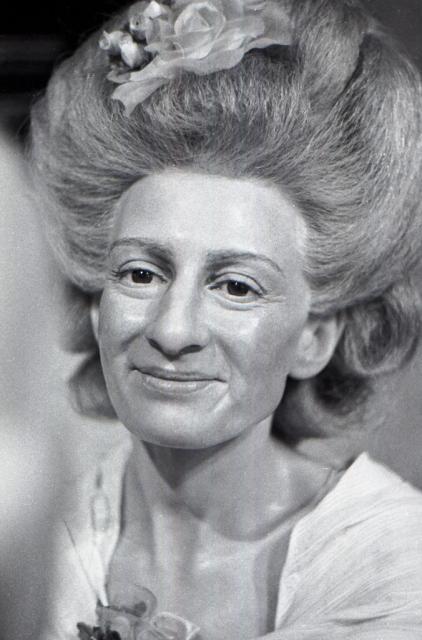
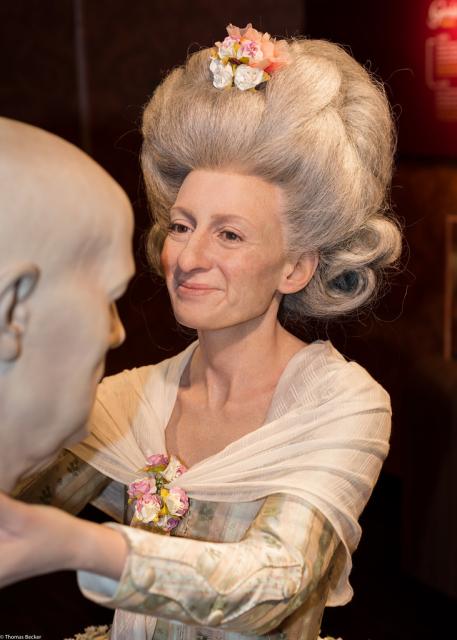
It was not easy for a young woman in the 18th century to carve her own path in life, especially if she did not possess beauty and only had the "illustrious" name of her father, Groscholtz, as her dowry. Unfortunately, his reputation was far from illustrious. Maria, from childhood, was accustomed to people avoiding them as if they were lepers. It's understandable, considering her father was a hereditary executioner. As you wander through the halls of the renowned London Wax Figure Museum, among the crowd of genius, villains, and modern celebrities, be sure to find a small sharp-nosed old woman in black. That is Madame Tussaud. She deserves to stand among the glittering circle of celebrities, not just as the founder of the museum. Madame's life could easily be the plot of an adventure novel.
Childhood and Apprenticeship
Madame Tussaud's official museum website provides a more respectable beginning to her story: "Her father was a soldier who participated in the Seven Years' War. He died two months before the birth of the girl, never having seen her. Her widowed mother worked as a housekeeper at Dr. Philippe Curtius' house, and later married him." Philippe Curtius was by no means destitute, unlike most of his colleagues in those times. As a supplier to the court of His Majesty the King of France, he crafted wax figures of the monarch, his numerous children, and household members. Little Marie could never be pulled away from her father's workshop. Eventually, he began teaching her all the secrets of his craft. His apprentice turned out to be remarkably talented, and Curtius thanked God for such a helper - he couldn't handle the influx of orders alone. The people of Paris clamored to have their portraits sculpted by the artist who crafted the king himself. Benjamin Franklin and Voltaire visited the workshop. Voltaire's figure became the first one 17-year-old Marie created on her own. Curtius realized that his daughter had a true talent, and soon entrusted her with making the death mask of Jean-Jacques Rousseau. Marie worked on orders all day long, and in the evenings "relaxed" by sculpting portraits of Curtius' guests - famous politicians, philosophers, and poets. Her artistic skills were recognized at court. One fine day, she was instructed to appear at Versailles: her duty now was to teach Madame Elizabeth, the sister of Louis XVI, the art of sculpture. Marie spent nine years in the splendor of Versailles. New wax figures appeared regularly, and her craftsmanship amazed the courtiers. Life seemed peaceful, and the future even more brilliant.

The Revolution and Revolutionaries
Everything changed on July 14, 1789. After the storming of the Bastille, the monarchy fell, and Marie and her mother found themselves imprisoned - in the same cell as Josephine de Beauharnais, the future wife of Napoleon Bonaparte. Their hair had already been cut off - the guillotine awaited them in the square. However, after some time, they were unexpectedly released. History remains silent about why. The court artist was free, but suspicions of sympathizing with the condemned were not lifted. Mademoiselle Groscholtz still had to earn the trust of the revolutionaries! And she did earn it, by sculpting the death masks of those she encountered daily in the corridors of Versailles, including Louis and Marie Antoinette. Real hair was needed for her work. Where to get it? From the heads of those executed by the guillotine! Among the Parisian executioners, Marie was still considered Groscholtz's daughter, and she received everything she needed. She quickly washed the bloodied heads of her former visitors and worked diligently on her collection. Now, she had new clients: Danton, Desmoulins, Robespierre.
Starting Over and The Chamber of Horrors
In Curtius' workshop, work resumed with fervor - they had to keep up with the guillotine. Electrified by the daily spectacle of death, the crowd demanded blood, regardless of whose. Once, the enemies were the subjects of Germany, and since Curtius, a German by nationality, had to flee Paris. Marie was left alone. One day, they came for her. They demanded she gather everything necessary for work and escorted her to a certain house. In an upstairs room, the body of Marat, killed by Charlotte Corday, lay cooling in a metal tub. The revolutionary guards had not yet taken the criminal away, and Marie greedily stared at Charlotte's face, capturing her features in her memory. Mechanically, she carried out her work, consumed by an unexpected idea. Upon returning home, she made a decision: to create not only individual figures but whole scenes. Thus, the first one was born - Marat and Charlotte.
The Success of Madame Tussaud
In 1794, Dr. Curtius passed away, and Marie inherited his business. She was 33 years old at the time. A few months after her father's death, she met engineer Francois Tussaud and soon married him. A year later, Marie gave birth to a daughter, but she did not live long. This was followed by the birth of two sons. Finally, she had a real family! But soon Marie had to admit to herself that she had made a less than fortunate choice. Francois turned out to be a heavy drinker and a compulsive gambler. He managed to squander everything his wife earned on cards. And there was a lot to lose. The business in the workshop was thriving, and Madame Tussaud's name was known throughout Paris. Her former cellmate, now Empress Josephine, invited her to the Tuileries Palace to sculpt a portrait of Napoleon's head... Madame Tussaud's wax figures soon left no space in the workshop for the artist herself. Her collection had to be seen by thousands of people! - Madame firmly believed in this.
Expansion and Legacy
In 1802, she made the decision. She left her husband, leaving her younger son with her mother, and with her elder son Joseph, embarked on a journey across the British Isles. Her wax figures captivated the English public, and people lined up to see them. But after two years, another trial awaited her: a cargo ship sank with most of her collection on board. Madame received the news without flinching, just like her official father, the executioner, upon discovering his wife's infidelity. She started again - luckily, she still had the molds for casting. The collection was recreated.
Madame's journey lasted thirty years and three. She never returned to her homeland. She loved England, enjoyed moving from city to city, and witnessing the excitement and buzz around her creations. Each new season brought new figures: Walter Scott and Shakespeare, Admiral Nelson and a little girl - Queen Victoria. The onlookers saw History frozen in wax before their eyes...
Madame, the artist, was particularly interested in villains who committed notorious crimes: their faces seemed so expressive, each one like a theatrical stage on which tragedy unfolded before the astonished audience. John Williams, the executioner of Edinburgh, granted Madame access to the prison, and she made masks of the criminals the day before their execution, and sometimes even after. Thus, she gradually filled her "Chamber of Horrors."
By the time Madame Tussaud passed away in 1850 at the age of 89, her work was known far beyond England. In 1884, thanks to her grandson Joseph Randall Tussaud, the collection found a permanent address. Interestingly, not far from Baker Street, where the museum is located today.
Madame found a second life among her creations. It's intriguing to wonder what they discuss when the last visitor leaves the museum, the lights dim in the halls, and the caretaker locks the doors.