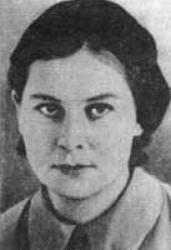
Anna Sopova
 Ukraine
Biography of Anna Sopova
Anna Dmitrievna Sopova was born on May 10, 1924, in the village of Shevyrivka, Krasnodon district, into a working-class family. In 1932, she started her education in the first grade, and in 1935, her family moved to the city of Krasnodon. Anna continued her studies at School No. 1 named after A.M. Gorky. She excelled academically, helped her classmates who were falling behind, and actively participated in school activities. She competed with the best students for the top academic performance in her class. The school's teaching staff awarded her with certificates, books, and twice she received tourist vouchers for the Caucasus region. In 1939, she joined the ranks of the Leninist Young Communist League (Komsomol) and quickly became involved in the organization's activities at her school. She was entrusted with the role of a squad leader and easily connected with her peers. Anna dreamed of becoming a pilot and often told the children about her favorite heroine, Valentina Grizodubova, and even invented games for them to play as "pilots."
Participation in the "Young Guard"
When the war started, like many other schoolchildren, Anna participated in the construction of defensive structures. She completed her 10th grade on the eve of the occupation of Krasnodon. In early October 1942, Anna joined the underground Komsomol organization "Young Guard," and her comrades elected her as the leader of the group of five. "In her character, there was a lot of gentleness, sensitivity, and kindness, along with heroism and courage," recalled her teacher, K.F. Kuznetsova. The group would gather at Anna's house or at Yuri Vitsenovsky's house, where they wrote leaflets, many of which Anna authored. She participated in numerous military operations.
Arrest and Death
Anna Sopova was arrested on January 25, 1943. Her parents remembered the morning of November 7, 1942: "Our daughter Nyusa was not at home in the evening. She returned only in the early morning. I didn't ask her any questions because I knew that Nyusa often stayed with friends. It was only in the morning that I noticed how radiant she was, with joy in her eyes. She kissed me and her mother with special delight, repeatedly saying: 'Under the scarlet flag, our people...'. I asked her, 'What are you talking about, Nyusa?' She led me outside and said, 'Look, Daddy.' I raised my head and saw the scarlet flag above the directorate."
When she was interrogated, they asked her whom she knew and had contact with, and what she had been doing. She remained silent. They ordered her to undress completely. She paled and did not move. She was beautiful, with her long, thick braids down to her waist. They tore off her clothes, wrapped a dress around her head, laid her on the floor, and began to whip her with a wire whip. She screamed horribly. When they started hitting her hands and head, she couldn't bear it and begged for mercy. Then she fell silent again. That's when Plokhih, one of the main police executioners, hit her in the head with something..." - from the memoirs of Alexandra Vasilyevna Tyulenyina. After the brutal torture, she was thrown into the shaft of Mine No. 5 on January 31. She was buried in a mass grave of heroes on the central square of Krasnodon.
Posthumous Recognition
Anna Dmitrievna Sopova was posthumously awarded the Order of the Patriotic War 1st class and the Medal "Partisan of the Patriotic War" 1st class.