Anthony Eden
 Great Britain
Anthony Eden: A Biography
Anthony Eden, also known as the 1st Earl of Avon, was an English conservative politician and statesman. He served as the Foreign Secretary from 1935-1938, 1940-1945, and 1951-1955, and as the Prime Minister from 1955-1957. Eden was born on June 12, 1897, in the family estate of Windlestone Hall, located in County Durham, one of the northern counties of England. His father, William Eden, the 7th Baron Eden, was married to Sybil Grey, whose family members also held high government positions. Anthony was the fourth child in the family and inherited not only his father's love for art but also his difficult temperament. Eden's upbringing was strict, and he often displayed bursts of irritation due to stress and fatigue.

After attending preparatory school in South Kensington at the age of eight, Anthony went on to a private school in Sandroyd, in the county of Surrey, where children of the English aristocracy were educated. He spent four years there and did not stand out among his peers. The same was true at Eton, where Anthony continued his education. He was a diligent and disciplined student but not particularly outstanding. At the age of 18, immediately after finishing school, Eden voluntarily enlisted in the front lines of World War I. Both his brothers, John and Nicholas, were killed in action. Eden's military service began in September 1915 in an infantry battalion, and he ended the war as a captain on the staff of the 1st English Army.

After being demobilized, Eden enrolled at Christ Church College, Oxford, where he chose to study Eastern languages, specifically Persian and Arabic. His knowledge of the East opened up good prospects for advancement in the diplomatic service. His first attempt to enter Parliament ended in failure, but his marriage to Beatrice Beckett, a banker's daughter, proved successful. Soon after, Eden was elected to Parliament from the Warwick and Leamington district. His position in this district became so secure that he represented it continuously for 33 years. In 1925, Eden became the personal parliamentary secretary to the Deputy Home Secretary, William Joynson-Hicks, and later, on Joynson-Hicks' recommendation, the parliamentary secretary to the Foreign Secretary, Austen Chamberlain.
Soon, Eden was sent as Britain's representative to the headquarters of the League of Nations in Geneva. By September 1931, he had become the deputy Foreign Secretary. His speeches in Geneva were widely advertised in the press, and newspapers were filled with photographs of the young and elegant minister. His partners in Geneva were prominent figures and diplomats of that time, such as the Frenchman Boncour, the German Neurath, the Austrian Dollfuss, the Italian Aloisi, the Czech Benes, the Romanian Titulescu, and the American observer Davis.
As the international situation deteriorated, Eden's actions quickly gained traction. By January 1, 1934, he was appointed as the Chancellor of the Duchy of Lancaster. His responsibilities remained the same – representation in the League of Nations and the issue of disarmament. By this time, Anthony Eden was only 36 years old but had already gained a reputation for solidity. In the eyes of the public, Eden embodied aristocracy, and many imitated his style. In the 1930s, London pursued the policy of appeasement towards aggressive powers such as Germany, Italy, and Japan. This policy aimed to temper their expansionist ambitions through territorial, military, economic, and political concessions.
On February 16, 1934, Anthony Eden embarked on his first tour of European capitals. He was warmly received in Berlin, where he discussed various armament issues with Adolf Hitler. From Berlin, Eden traveled to Rome, where Mussolini supported Hitler's demands regarding German rearmament. These discussions in Berlin and Rome did not yield any practical results, but they demonstrated England's willingness to follow the path of appeasement towards fascism.
On September 17, 1934, the Soviet Union joined the League of Nations. On this occasion, Eden delivered a speech in which he stated that it was a step towards the universality of the organization.
During the war, Eden worked tirelessly and sacrificed his personal life for the sake of his duties. He rarely had time for leisure or family, and his wife referred to herself as a "diplomat's widow." Eden had two sons, Simon (born in 1925) and Nicholas (born in 1930). Despite his busy schedule, Eden enjoyed sports, particularly tennis, on weekends. However, a significant portion of his time was spent on the road.
In early 1935, Eden once again traveled to European capitals. These trips were prompted by the British government's decision to seek an agreement with Fascist Germany. In Neville Chamberlain's cabinet, Eden became the Foreign Secretary. However, this did not mean a change in the appeasement policy. As a young minister without real power, Eden began to understand that the policy of appeasement was doomed to fail. He resigned in February 1938 as an opponent of appeasement and a proponent of firm resistance against aggressive powers.
In December 1938, Eden and his wife visited the United States. The world was moving towards war, and the interests of England and the United States were expected to align. The Americans paid close attention to Eden, and he delivered speeches at numerous lunches and receptions. American diplomats saw Eden as the ideal American.
In March 1939, Hitler seized Czechoslovakia without consulting the participants of the Munich Agreement. The elimination of the Munich Agreements convinced Eden that the policy of appeasement had put Britain and France in a dangerous position. He called for the conclusion of a "triple alliance between Britain, France, and Russia based on full reciprocity," meaning that "if Russia is attacked, Britain and France must come to its aid." In early May, Eden spoke in the House of Commons in favor of a quick agreement with the Soviet Union.
Eden believed that efforts by fascism to expand its conquests in Europe, along with its threat of war against England, must be stopped. In a letter to one of his correspondents, he wrote, "If we can make Germany believe that we will fight, then eventually we can do something to prevent the outbreak of war."
On September 3, 1939, Great Britain entered the war, and on the same day, Eden took on the role of Dominion Secretary. After Neville Chamberlain's resignation and Winston Churchill's assumption of power, Eden became the Foreign Secretary. According to official historian L. Woodward, "Eden was able to balance and often modify the rapid Churchillian approach to events and similarly rapid conclusions." Woodward believed that Eden was a "realist, inclined by temperament to reason with respect to remote consequences and ultimate considerations."
During the war, Eden famously said, "In times of war, diplomacy and strategy are twins." However, the success of foreign policy depends not only on the skill of diplomats but also on the economic, military, and political power on which diplomacy is based. Arthur Balfour, the British Foreign Secretary during World War I, once wrote, "If the failures of diplomacy can hamper the actions of the army, the failure of military actions makes the Foreign Office helpless." This was precisely the position of British foreign policy between the capitulation of France and the Soviet Union's entry into the war.
This uncertainty persisted even after the signing of the agreement on July 12, 1941, between the governments of the Soviet Union and Britain for joint action against Germany, in which both sides pledged to assist and support each other in the war and not negotiate or conclude a separate armistice or peace treaty with Germany.
In December 1941, Eden visited Moscow, and in May 1942, Soviet Foreign Minister Vyacheslav Molotov visited London. They signed the Treaty between the Soviet Union and Britain on the alliance in the war against Hitler's Germany and its allies in Europe and on cooperation and mutual assistance after the war.
In March, Eden traveled to the United States to discuss post-war problems with his American counterparts.
Roosevelt had many conversations with Eden during his 18-day visit, often discussing the future of the world over tea or lunch. Biographers of Eden quote a telegram from Roosevelt to Churchill in which the President stated that he spent three evenings with Eden and found him to be a "splendid chap," and that they agreed on 95% of the issues discussed.
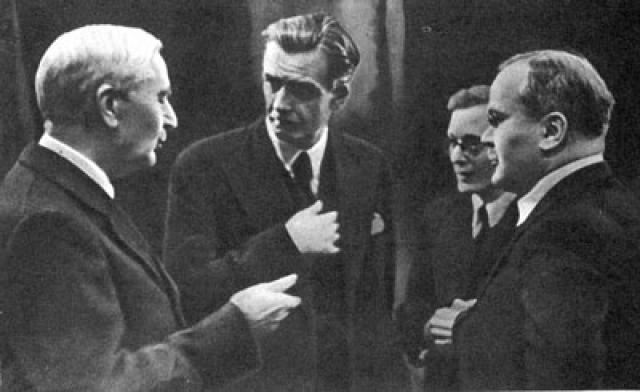
The disagreements between the members of the anti-Hitler coalition were set aside in favor of the main task of ensuring victory over Germany, Italy, Japan, and their allies. Many conferences of the "Big Three" were dedicated to this goal, where, in addition to the heads of government, foreign ministers also participated. Eden persistently and successfully pushed for bilateral meetings to precede the trilateral meetings, where British and American representatives prepared joint decisions on the issues under consideration. This meant that they acted based on prior agreement. Historian Gabriel Kolko writes, "When Americans and British could agree, and containing Bolshevism was surely one of the few issues they were unanimous about, there were, in effect, two coalitions fighting the Axis powers. The first coalition was between Britain and the United States, a true alliance in the sense that both countries held a common view of fundamental problems, but it did not preclude serious conflicts between them. The second coalition was between the Anglo-American bloc, in which both countries acted in agreement, and the Soviet Union."
Using the alliance with the United States and the Soviet Union in the interests of Britain was perhaps Eden's main task, but not the only one. The war had a global scale, and British interests were present in every corner of the globe. Dealing with General de Gaulle, who led the French Committee of National Liberation, required a great deal of effort and patience. The war in the Pacific and Asia, although primarily an American concern, presented numerous problems for the Foreign Office.
Eden participated in the Moscow, Tehran, Crimea (Yalta), San Francisco, and finally, Berlin (Potsdam) conferences.
The war ended for capitalist Britain as a "triumph and tragedy." The triumph was the victory over the most dangerous enemy in the country's history, and the tragedy was the post-war "dramatic decline in British power." This phrase belongs to one of Britain's prime ministers, Harold Macmillan.
After the war, Eden participated in numerous conferences. In 1955, he became the Prime Minister of Great Britain. However, after a failed attempt to resolve the Suez Crisis by force with France and Israel, he was forced to resign. For his services to the country, Eden was honored with the earldom of Avon and was referred to as Earl Avon.
After his resignation, Eden wrote memoirs and traveled extensively.
In January 1977, Eden was vacationing in Florida at the villa of the well-known American millionaire and diplomat, Averell Harriman. By this time, he had been diagnosed with liver cancer. He became seriously ill during his stay and was evacuated to England on a military plane sent by the British government. Anthony Eden passed away in his sleep at the age of 79 in his home in Alvediston. Twenty years had passed since his resignation as Prime Minister.
Anthony Eden was buried in Alvediston, where he lived. His title, Earl Avon, was inherited by his son Nicholas, who became a banker.