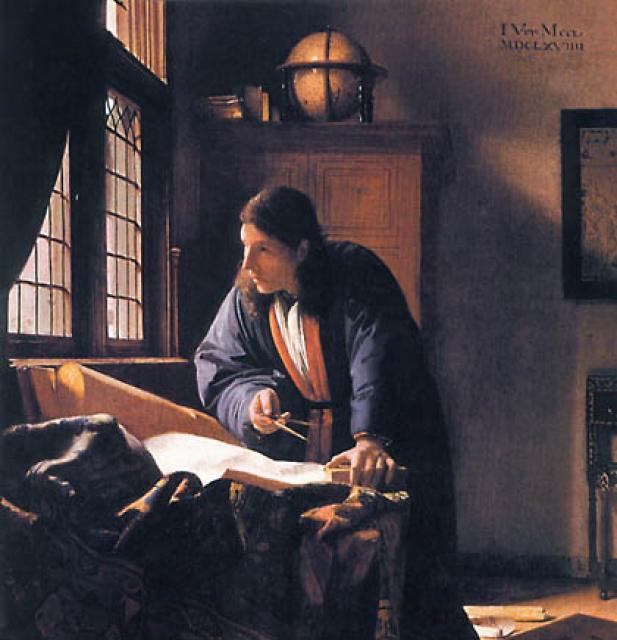
Antoni van Levenguk
 Netherlands
Antony van Leeuwenhoek: A Self-Taught Naturalist and Scientist
Antony van Leeuwenhoek, a self-taught naturalist, was the first to observe Microbes, Spermatozoa, and the Slipper Animalcule. Born in 1632 in Delft, Netherlands, he spent his entire life buying and selling paintings, following in his father's footsteps. He also dabbled in painting himself. However, during his lifetime, he did not achieve much recognition. His realistic depictions of everyday life did not captivate his contemporaries. It took two hundred years for van Leeuwenhoek's talent to be discovered. In 1866, French writer and art critic Toré-Bürguer published a series of enthusiastic articles about the artist, bringing him into the limelight during the era of the Impressionists. These articles praised van Leeuwenhoek's remarkable use of light in his paintings and his exquisite technique of applying paint to the canvas.

Antony van Leeuwenhoek: Biography
Antony van Leeuwenhoek, a self-taught naturalist, was born in Delft, Netherlands in 1632. He was a contemporary and fellow countryman of Jan Vermeer. At a young age, van Leeuwenhoek was apprenticed to a fabric merchant and soon began trading on his own. He later moved to Amsterdam and worked as a cashier and accountant in a trading establishment. Eventually, he returned to Delft and served as a bailiff for the court. At first glance, van Leeuwenhoek seemed like an ordinary man, but hidden within him was the passion of a true explorer. Throughout his life, he strived to "satisfy his passion for delving into the essence of things." In his early years, van Leeuwenhoek became fascinated with glass grinding, practicing it with such enthusiasm that he achieved astonishing results. The lenses he created, no larger than a large pea, had the ability to magnify objects several hundred times. After his death, a whole collection of 172 lenses and 273 microscopes was discovered in his working office, which he referred to as his museum.
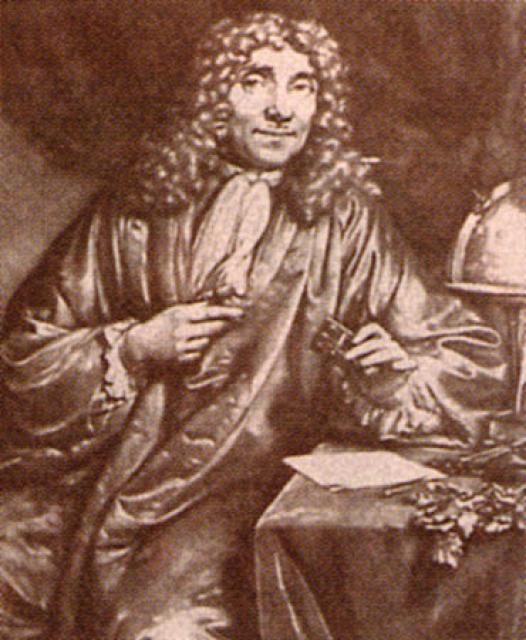
Van Leeuwenhoek's insatiable curiosity led him to explore the microscopic world. He was one of the first to conduct experiments on himself, turning his own body into a walking laboratory. He examined his blood and pieces of his skin, sacrificing them for the sake of science. He was the first to observe red blood cells, which later proved to be the reason for the red color of blood. Van Leeuwenhoek also made groundbreaking discoveries about spermatozoa. He experimented with medicines, studying the effects on his body, and examined bodily secretions based on the quality of his diet. When he needed to investigate the peculiarities of lice reproduction, he fearlessly placed them in his own stocking. Even on his deathbed, van Leeuwenhoek meticulously described the process of life fading away from his body. He became the founder of a new science - microbiology. Eager to understand the forces that "act on the tongue and cause its irritation," he placed a piece of horseradish root in water. To his amazement, he observed "a large number of tiny living creatures in the water. Some were three or four times longer than they were wide, with a regular oval shape. There were also the most numerous, the smallest creatures with tails." This bizarre world of rod-shaped, spiral-shaped, spherical, and variously shaped microorganisms captured the researcher's entire attention. Over fifty years of work, van Leeuwenhoek discovered over two hundred species of microorganisms.
The results of his experiments were carefully documented and sent to England. The learned men of the Royal Society marveled at his reports. Eventually, van Leeuwenhoek's achievements gained official recognition. In 1680, he was elected a Fellow of the Royal Society of London. Later, he was also accepted into the French Academy of Sciences. His discoveries became a sensation. People flocked to Delft to pay royal honors to the microbes. Even crowned individuals bent their regal heads over his magical lenses, eager to get a better look at the Slipper Animalcule. In 1698, van Leeuwenhoek had a memorable meeting with Peter the Great. The famous English writer Jonathan Swift also visited van Leeuwenhoek. The microorganisms he encountered inspired Swift to write "Gulliver's Travels." Van Leeuwenhoek and Vermeer must have known each other; Delft was too small for two well-known individuals, both baptized in the same church, not to cross paths in their hometown. These two remarkable Dutchmen could have been close friends. After Vermeer's death, van Leeuwenhoek was appointed his executor.
The interests of the artist and the scientist clearly overlapped. American researcher Arthur Wheelock noted that after 1655, when van Leeuwenhoek became interested in astronomy and navigation, Vermeer's paintings also started featuring meticulously reproduced maps and globes. In the painting "The Astronomer," for example, the starry sky globe of Jodocus Hondius is accurately depicted (it was first published in 1660). Several constellations can even be distinguished (the Big Dipper is on the left).
Van Leeuwenhoek and Vermeer could have been brought together by their interest in optics. Certain aspects of Vermeer's works, such as emphasized perspective, blurred foregrounds, and light reflections, suggest a familiarity with the camera obscura, the precursor to modern photography. However, if Vermeer did use it, he did so not as a mere copyist but as an explorer. Like van Leeuwenhoek, he studied the life of matter and light, striving to capture what he saw using the latest technical advancements.
Van Leeuwenhoek could have posed for both paintings, as well as acted as a patron. In 1668, he would have been thirty-five years old, a perfect age to represent the scientist in Vermeer's works. Although Antony had not yet achieved fame for his discoveries in microbiology, he was already known as an expert in astronomy and geography.
A portrait of the naturalist painted by Jan Verkolje in 1686 has survived. The scientist depicted in Vermeer's paintings resembles van Leeuwenhoek in Verkolje's portrait. It only takes removing the wig and subtracting twenty years.


