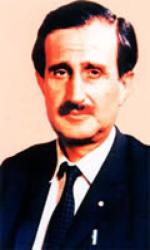
Antonio dos Santos Ramalho Eanes
 Portugal
António dos Santos Ramalho Eanes: A Biography
António dos Santos Ramalho Eanes was a Portuguese political and military leader who served as the President of the Portuguese Republic from 1976 to 1986. He was born on January 25, 1935, in the city of Alcains, in the province of Beira-Baixa (now the municipality of Castelo Branco, in the Beira Interior Sul statistical region, Central region), to Manuel dos Santos Eanes, an engineer, and Maria do Rosário Ramalho.

Eanes attended a lyceum in Castelo Branco and graduated in 1952. He then volunteered for the military and joined a general military school. In 1956, Eanes completed his military training and became a second lieutenant. He served as an instructor at an artillery school in Mafra before being sent to the Portuguese enclave of Goa in India in 1958. He was promoted to lieutenant while in India. In 1960, Eanes returned to Portugal, and in December of the following year, Goa was captured by the Indian army.

During his service in Lisbon, Eanes excelled in army sports competitions, particularly in athletics. He was promoted to captain in 1961 and attended Special Operations Training Courses. In the same year, he was assigned to Macau, a Portuguese colony on the coast of China. In 1964, he briefly served in Mozambique and then returned in 1966, where he dealt with propaganda and experienced a conflict between official orders and human principles. In 1968, Eanes returned to Portugal and completed a course in psychological actions at the Institute of Advanced Military Studies.
While continuing his military service, Eanes also graduated from the Law Faculty of the University of Lisbon, specializing in political science and constitutional law. He also completed a three-year course at the Higher Institute of Applied Psychology. In 1969, Eanes was sent to Portuguese Guinea, where he served under the command of Governor General António de Spínola, heading the Broadcasting and Press Service, as well as the Civil Affairs and Psychological Actions Department under the governor. It was during this time that he met Captain Otelo Saraiva de Carvalho. Eanes developed a good relationship with Governor Spínola, which later led to him being considered a "spinolista". In 1970, Eanes became a major candidate, and in 1971, he was sent on a mission to Angola, where he distinguished himself in service. In 1973, he was promoted to major.
Eanes played a significant role in organizing the first Congress of Combatants of the Ultramar War in June 1973, held in Porto. Together with Hugo dos Santos and Vasco Lourenço, he circulated a petition expressing protests and advocated for it. At the end of 1973, Eanes participated in meetings of the Captains' Movement and was sent back to Angola in January 1974. In 1974, he was promoted to lieutenant colonel. During the Carnation Revolution, Eanes was in Angola and did not participate in the events in the capital. On April 30, 1974, he was appointed the head of the Special Commission for Mass Communication. However, he only returned to Lisbon in July 1974. He became the director of programs at the Portuguese Radio and Television, and later, on September 28, 1974, he became the Chairman of the Administrative Council of the Portuguese Radio and Television (RTP). In March 1975, Eanes was dismissed from this position after General Spínola attempted a coup. Left-leaning officers accused him of being a "reactionary" due to his friendship with Spínola. Eanes resigned but demanded an investigation into his activities, claiming that he did not support Spínola. He continued to work in the Revolutionary Council and was subsequently assigned to the General Staff of the Army. He later led the Operational Group in Amadora. In August, he supported the "Group of Nine" and became responsible for the military operation to restore control over the army. Eanes actively participated in the November Crisis and on November 28, he temporarily assumed the position of Chief of the General Staff of the Land Forces after the resignation of General Carlos Fabiano. On the same day, he was promoted to general by position.
On December 1, Eanes joined the Revolutionary Council, and on December 6, 1975, he officially became the Chief of the General Staff of the Land Forces. In 1976, Eanes, who remained a general by position, was promoted to colonel due to his years of service. In 1976, Eanes' candidacy was put forward for the upcoming presidential elections. He was supported by three out of the four major political parties in the country: on April 28, the People's Democratic Party expressed its support, followed by the Portuguese Socialist Party on May 12. The Democratic Renewal Party also supported the general. On May 14, Eanes' candidacy was registered, and in early June, the Supreme Court declared it lawful. In the elections held on June 27, 1976, he achieved a convincing victory. On March 18, 1986, as a former president, Eanes was appointed a lifelong state advisor. On August 19, 1986, Eanes became the President of the Democratic Renewal Party, but he left this position on August 5, 1987. On July 19, 1987, he was elected as a member of the Assembly of the Republic.
In 2000, for moral and ethical reasons, Eanes renounced his military rank of marshal. On June 3, 2005, a conference titled "Ramalho Eanes: The Spirit and the Letter of a Presidential Mission" was held at the Bernardino Machado Museum, dedicated to Eanes as the first president elected after the dictatorship. It was organized by Professor Norberto Cunha, the museum director and rector of the Polytechnic Institute. On November 15, 2006, Eanes was awarded a doctorate in political science from the University of Navarra in Pamplona for his thesis on "Civil Society and Political Forces in Portugal". Eanes actively participates in official events, as well as various public and scientific forums. In November 2009, he spoke at a conference commemorating Ernesto Melo Antunes. Eanes has received numerous military and state awards, including the War Cross and the Silver Medal for Distinguished Services with Palm. He is also a knight of the Order of the Tower and Sword.