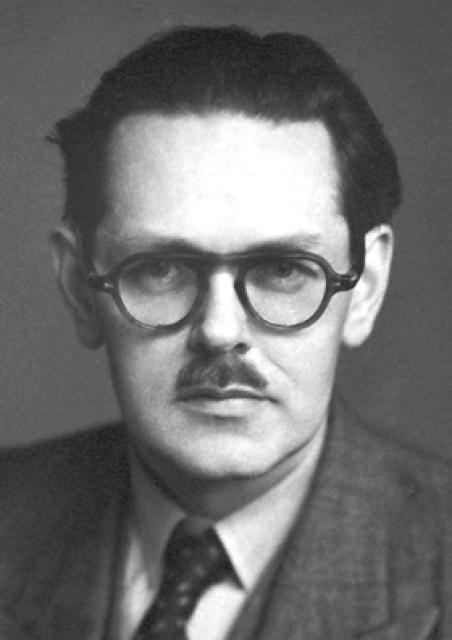
Archer Martin
 Great Britain
- Archer Martin: A Biography
- Early Career and Chromatography
- Advancements in Chromatography
- Contributions to Science and Nobel Prize
- Later Career and Recognition
- Personal Life and Hobbies
Archer Martin: A Biography
Archer Martin, an English biochemist, was awarded the Nobel Prize in Chemistry in 1952, alongside Richard Synge. He was the youngest of four children and the only son in a family of nurse Lillian Kate (Brown) and physician William Archer Porter Martin. At the age of 19, Martin entered the University of Cambridge, receiving a scholarship that allowed him to pursue a degree in chemical engineering. However, after meeting biologist J.B.S. Haldane, Martin became interested in biology and changed the direction of his scientific studies. He obtained a bachelor's degree in biochemistry in 1932 and a doctoral degree in 1936.
Early Career and Chromatography
While a student at the University of Cambridge, Martin worked at the Dunn Nutritional Laboratory on the separation and extraction of vitamins. Through this work, he gained significant experience in separating closely related chemical components using methods such as fractional distillation, solvent extraction, and other similar technologies related to the distribution of components between two phases. Martin's research led to the development of the chromatographic method known as counter-current distribution, where a mixture to be separated is repeatedly dissolved in two immiscible solvents moving in opposite directions. This method allows for the separation of components based on their affinity with the solvents, leading to the development of chromatography as a powerful analytical technique.
Advancements in Chromatography
Martin and his collaborator, Richard Synge, applied the principles of counter-current distribution to column chromatography. They used silica gel columns as the stationary phase, chloroform as the mobile phase, and methyl orange as the indicator. By reacting the separated amino acids with ninhydrin and comparing the individual bands with pure compounds, they were able to determine the composition of the amino acid mixture. This analytical approach was named partition chromatography, as it relied on the chemical distribution of the dissolved substance between the two solvents used in the column. Unlike adsorption chromatography, partition chromatography allowed for a wider choice of solvents and stationary materials.
Contributions to Science and Nobel Prize
In 1952, Martin and Synge were awarded the Nobel Prize in Chemistry "for their invention of partition chromatography." Their method provided scientists with a new tool that proved useful in numerous important scientific investigations. The technique enabled researchers in the fields of chemistry, biology, and medicine to tackle previously insurmountable problems. In 1953, Martin and E.T. James developed the technique of gas-liquid chromatography, which used an inert gas as the mobile phase and a non-volatile liquid impregnated solid as the stationary phase. This method was particularly useful for the characterization of fatty acids and steroid mixtures.
Later Career and Recognition
From 1959 to 1970, Martin served as the director of the Abbottsbarry Laboratory Limited. He then worked as a consultant for the Welcome Foundation Limited for three years before joining the Medical Research Council as a Professor of Chemistry at the University of Sussex. Archer Martin received numerous awards throughout his career, including the Berzelius Medal from the Swedish Medical Society (1951), the John Scott Award from the City of Philadelphia (1958), the John Price Wetherill Medal (1959), the Franklin Medal from the Franklin Institute (1959), and the Order of the Rising Sun from the Japanese government (1972). He was a member of the Royal Society and several other scientific societies.
Personal Life and Hobbies
In 1943, Martin married teacher Judith Beadnell. The couple had three daughters and two sons. In his youth, Martin enjoyed mountaineering, gliding, and jiu-jitsu.


