Arno Peters
 Germany
Biography of Arno Peters
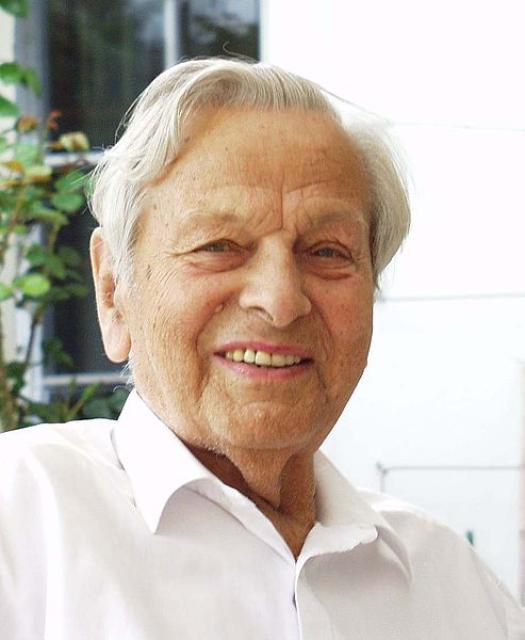
Arno Peters, a German researcher and thinker, was born in Berlin in 1916. He was a geographer, historian, economist, and humanist. Peters challenged the Eurocentric view of world history and advocated for a more neutral historical perspective. He was the founder of the theory of "equivalent economics" and a supporter of a new global order based on socialist principles. Peters criticized the capitalist form of economy.
After completing his secondary education, Peters studied history and journalism at the University of Berlin. He earned his doctorate degree in 1945. From 1974, he worked as the director of the Institute of Universal History in Bremen. Peters was also a father of seven children and had diverse interests, including being an amateur artist and enjoying swimming, cycling, and sailing. He passed away on December 2, 2002, in Bremen.
Arno Peters can be considered a universal scholar as his research covered various disciplines such as history, cartography, social sciences, politics, economics, and music. He aimed to overcome Eurocentrism in historical disciplines and developed the Synchronoptic World History concept in 1952. This concept presented 25 different historical civilizations and cultures of the world, compared with each other in a synchronized and tabular form. In this perspective, European civilization holds an equal place among other civilizations from Asia, America, and Africa. This differs from Eurocentric historiography, which views civilizations as either sequential or independent from each other. Peters emphasized that cultures and civilizations develop and influence each other over time.
Peters also fought against Eurocentrism in modern cartography. In 1973, he created the Peters Projection map, which displays the Earth's surface in its undistorted form by using an equal-area projection and replacing the traditional latitude-longitude grid with a rectangular (orthogonal) decimal grid. This eliminated the distortion of land surface areas that occurred in maps using the conventional grid, where territories were stretched in the east-west direction and compressed in the north-south direction. As a result of Peters' method, the size of Europe was visually reduced, and it was shifted to the north, while Africa, Asia, and Latin America, due to their larger areas, occupied a more central position.
The Peters Projection map, besides its technical innovations for a more objective reflection of physical reality, caused political controversy in Europe, opposing the disruption of the established Eurocentric view expressed in traditional cartography. To date, more than 80 million copies of the Peters Projection map have been published in various countries and on seven languages.
Based on this map, Peters published the Peters Atlas in 1989, which presented individual countries in the world on an equal scale, a novelty in cartography. It allowed for a direct comparison of the size of countries with each other. Similarly to the Peters Projection map, the atlas aimed to eliminate Eurocentrism in cartography and offered an objective view of the physical-geographical parameters of countries. In most atlases, half of the space was occupied by enlarged maps of European countries, while the remaining 15/16 part of the land was depicted in a reduced scale. In Peters' atlas, all countries in the world are represented on an equal scale. European countries appear quite small, compared to others, which caused resonance in the European world.
The Peters Atlas was published by UNICEF and major European publishing houses. In 1984, Peters developed a method for recording sounds using colors (Peters Recording). He applied his previously developed method of optical representation of historical time to music, representing pitch in its optical-color variant. This made it possible to record any sound with color and in the form of a graphical bar, where the height corresponds to the length of an octave. Since 1983, Peters started working on the theory of "equivalent economics." His goal was to create an economic system that would satisfy the needs of all people. Peters believed that both global and local economies are oriented not towards the real needs of people but towards demand and supply for the purpose of making a profit.
However, the absence of effective demand does not negate the existence of a real need for a product or service. Peters saw the main purpose of the economy in satisfying people's needs. Following Aristotle, Peters divided the economy into a basis aimed at meeting needs and chrematistics, which involves making income from money itself (capital profit).
As an alternative to the capitalist economy, Peters proposed the model of "Equivalent Economics," in which goods and services are exchanged based not on monetary price but on value. Following David Ricardo, Peters defined the value of any good or service as the sum of all the labor time invested in it. Labor time, the expenditure of human working hours, is the value of the produced goods or services. Peters believed that the exchange of goods and services should strictly correspond to the labor time spent on their production, regardless of the nature and type of work. The value of 8 hours of a factory director's time is strictly equal to the value of 8 hours of work by a locksmith or a cleaner. The objectivity of the time value as a measurement scale makes it universal. According to Peters, this ensures the fair distribution of goods and services not only within society but also between countries. Peters developed a special matrix, called the Peters Rose, to calculate the value of the final product or service, into which the labor time of individual production participants is loaded.
Arno Peters was the ideological mentor of Heinz Dieterich, a well-known Latin American socialist and activist of German descent. Dieterich actively participated in the circle around Venezuelan President Hugo Chavez in implementing socialist reforms in the country. Chavez's political slogan, to bring Venezuela into the "Socialism of the 21st Century," was derived from Dieterich's book of the same name (1996), based on Peters' ideas of computer-planned and equivalent economics. Dieterich maintained personal contact with Peters until his death in 2002.