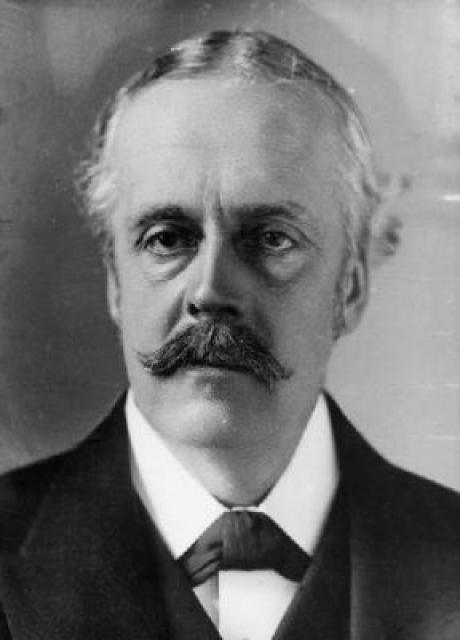
Arthur Balfour
 Great Britain
Biography of Arthur Balfour
Arthur James Balfour (1848–1930) was a British statesman who held various important positions in the government. He was born on July 25, 1848, in Whittingehame, Scotland. Balfour studied at Trinity College, Cambridge University, before entering politics.

In 1874, he became a member of the House of Commons representing the Conservative Party. During the Berlin Congress in 1878, he served as a secretary to his uncle, Lord Salisbury, the Foreign Secretary at the time.
In 1886, Balfour joined the government as the Minister for Scotland, and from 1887 to 1891, he served as the Chief Secretary for Ireland. In 1891, he became the First Lord of the Treasury and the leader of the House of Commons.
In 1902, Balfour succeeded Lord Salisbury as the Prime Minister and the leader of the Conservative Party. During his time in office, he implemented reforms in education and defense. He played a significant role in the Anglo-Japanese Alliance of 1902, which ended Britain's policy of "splendid isolation." Balfour also established an alliance with France, laying the foundation for the anti-German coalition.
However, in 1903, the Conservative Party faced a split over the issue of tariffs and customs reform, which undermined the government's position. Balfour resigned in late 1905, and the Conservatives suffered a defeat in the parliamentary elections in December of the same year.
From 1910 to 1911, Balfour opposed the Home Rule for Ireland and the limitation of the powers of the House of Lords, but he was unsuccessful in his efforts. In November 1911, he was forced to step down as the leader of the Conservative Party.
During World War I, Balfour served in the coalition government as the First Lord of the Admiralty. From 1916 to 1919, he held the position of Foreign Secretary and actively opposed pacifism, supporting Lloyd George's policy of "knockout blow." In April 1917, he led a mission to the United States to coordinate military actions in Europe. In the same year, the Balfour Declaration was issued, expressing Britain's favorable stance towards the establishment of a national home for the Jewish people in Palestine.
In 1920, Balfour represented Britain at the League of Nations Assembly, and from 1921 to 1922, he attended the Washington Naval Conference on limitations of naval armaments and Pacific and Far Eastern issues. In 1922, he was knighted as a Knight of the Order of the Garter and received the title of Earl of Balfour.
In 1926, Balfour led the work on the "Balfour Report," the conclusions of the Imperial Conference on self-government for the dominions of Canada, South Africa, Australia, New Zealand, and the Irish Free State. These conclusions were included in the text of the Statute of Westminster (1931).
Throughout his life, Balfour had a profound interest in philosophy and wrote several works in the field. He served as the President of the British Academy from 1921 to 1928. Some of his notable works include "Defence of Philosophic Doubt" (1879), "The Foundations of Belief" (1895), and "Theism and Humanism" (1915).


