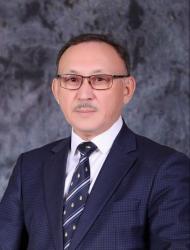
Asan Ospanov
 Kazakhstan
- Education and Early Career
- Research in Food and Agricultural Engineering
- University and Research Leadership
- Recognition and Legacy
Asan Bekeshovich Ospanov is a Kazakh engineer, professor, and researcher in food-processing technology. Born on 18 May 1961 in Dzhambul, now Taraz, he trained in the design and operation of machinery for food production. Over the course of his career, he has combined university teaching with research on how grain, milk, and other agricultural raw materials can be processed more efficiently.
Education and Early Career
Ospanov graduated in mechanical engineering from the Zhambyl Technological Institute of Light and Food Industries. He continued his specialist training in Moscow at the Technological Institute of the Food Industry, focusing on the theory of mechanisms, machines, and robots used in food production. He earned advanced degrees in technical sciences and became a professor, building his research around the equipment and processes that connect agricultural production to food manufacturing.
In 1983, he began teaching at the institute in Zhambyl, now Taraz. Over the following years, he worked as an assistant, senior lecturer, associate professor, and department head, and also served as a deputy dean. His early academic work centered on food engineering: the design and study of equipment that separates, mills, presses, mixes, dries, or otherwise transforms raw materials.
Research in Food and Agricultural Engineering
Ospanov’s research has addressed practical problems in grain processing and food production. His early dissertation work examined separating mixtures of hulled and unhulled rice using vibration and self-sorting. Later, his work expanded to vibration separators for grain, oilseeds, and cereals, as well as processes used in flour, pasta, bakery, confectionery, and animal-feed production.
He has also explored technologies using electromagnetic and microwave energy to dry or disinfect grain and pasteurize milk. More recent projects have included a separator for cleaning forage-grass seeds, yoghurt made from small-ruminant milk with fruit concentrate, and complete dry food for service dogs. Across these subjects, his interest has been to improve the performance of machinery and production lines while making better use of agricultural crops and by-products.
University and Research Leadership
Ospanov’s academic career developed into university and research administration. In 2001, he became head of the Food Engineering Department and director of the Research Institute of Food Technologies at Almaty Technological University. From 2002 he led an agricultural mechanization research center under Kazakhstan’s Ministry of Agriculture, where he coordinated state-supported projects and helped establish an accredited machinery-testing laboratory.
Between 2007 and 2013, he held senior academic posts at Almaty Technological University, including vice-rector for academic affairs, vice-rector for research, and first vice-rector. He later became rector of Eurasian Technological University, serving from 2013 to 2016. He returned to agricultural research leadership as deputy director for science at the Kazakh Research Institute of Mechanization and Electrification of Agriculture, then became head of the Kazakh Research Institute of Processing and Food Industry in 2018. He has continued to teach and conduct research, and has recently served as a chief researcher on projects in food-production engineering.
Ospanov has supervised postgraduate researchers and helped train engineers and scholars in food processing. His academic profile records a substantial body of scientific publications, patents, textbooks, and monographs. He has collaborated with researchers in Kazakhstan and abroad, including on a multilingual textbook about processes and equipment used in food production.
Recognition and Legacy
Ospanov has received national recognition for his contribution to science and education. He was awarded Kazakhstan’s Order of Qurmet in 2015 and the Ministry of Education and Science’s “Best University Teacher” title in 2017. He also received a state scientific scholarship recognizing contributions to science and technology.
His career reflects the close ties between engineering research and food security: the quality and efficiency of processing can determine how much value is gained from crops and livestock products. Through research, teaching, and leadership, Ospanov has helped develop technologies for Kazakhstan’s agricultural and food industries and prepared new specialists to continue that work.