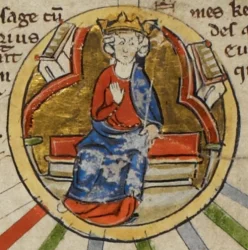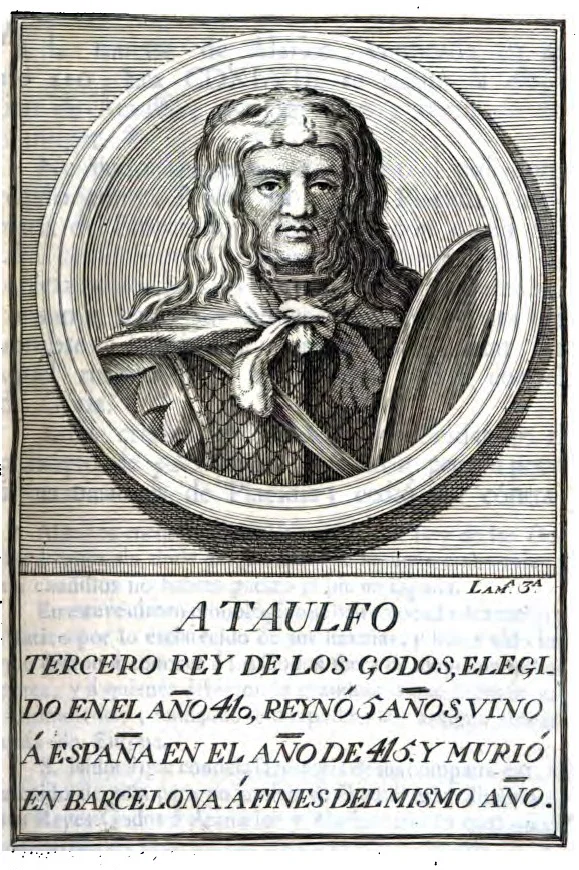
Ataulf
- Successor to Alaric
- A marriage with political weight
- From Gaul to Spain
- Assassination in Barcelona
- A transitional ruler
Ataulf ruled the Visigoths during a period when the Western Roman Empire was struggling to maintain control of its provinces. A successor to Alaric, he led his people from Italy into Gaul and then Spain, shifting between conflict and negotiation with Rome. His marriage to the Roman princess Galla Placidia became one of the era’s most striking political unions, but his reign ended in assassination after only a few years.
Successor to Alaric
Ataulf, also known as Athaulf or Ataulphus, was a kinsman and brother-in-law of Alaric, the Visigothic king whose forces sacked Rome in 410. After Alaric died later that year, Ataulf succeeded him as leader. The Visigoths were then a powerful but mobile people, seeking territory, supplies and security as the western Roman state fractured around them.
In 412, Ataulf moved the Visigoths from Italy into southern Gaul. There he became involved in the struggles among Roman claimants to power, initially supporting the usurper Jovinus. When that alliance collapsed, Ataulf shifted sides, helping the Western emperor Honorius defeat Jovinus. The maneuver reflected the political reality of the time: Roman and Gothic leaders negotiated and fought as they pursued their own survival and influence.
A marriage with political weight
Among the captives taken during the sack of Rome was Galla Placidia, half-sister of Emperor Honorius. Ataulf married her at Narbonne in 414, in a ceremony described by later writers as deliberately Roman in style. The union was both personal and political, linking the Visigothic king to the imperial family while Rome and the Goths continued to bargain over territory and status.
Their son, Theodosius, was born in 414 or 415 but died in infancy. His death ended the possibility of a direct child bridging the Roman and Visigothic dynasties.
From Gaul to Spain
Ataulf’s forces occupied important cities in southern Gaul, including Narbonne, Toulouse and Bordeaux. But the Western Roman general Constantius blockaded the ports and cut off supplies. Facing mounting pressure, Ataulf led the Visigoths across the Pyrenees into Spain in 415, establishing a base around Barcelona while continuing to seek an accommodation with the empire.
Later accounts attribute to Ataulf a change in outlook: he supposedly abandoned the idea of destroying Rome and instead sought to rebuild Roman power with Gothic strength. The famous statement survives through Christian writers and should be treated as a reported sentiment rather than a verbatim political manifesto. In practice, his policies combined bargaining and warfare as he tried to secure a lasting place for his people.
Assassination in Barcelona
In 415, Ataulf was murdered in Barcelona by a member of his own household, reportedly while visiting the royal stables. The killing has been linked in later accounts to private vengeance, including the death of a rival Gothic leader, though the precise motives are uncertain. He was succeeded briefly by Sigeric, whose violent accession was followed by the elevation of Wallia.
Galla Placidia was returned to Roman control in 416 and later married Constantius, who became emperor. The shifting fortunes of the royal couple mirrored the instability of the period, when family ties, hostages and marriage alliances were all part of high politics.
A transitional ruler
Ataulf’s reign was short, but it marked a major stage in the Visigoths’ movement toward settlement in the western provinces. His campaigns and negotiations helped shape their passage from Italy through Gaul into Spain. The stable kingdom that later emerged was not yet his achievement, but his rule was one of the decisive chapters in the transformation of Roman lands into post-Roman states.