Robert Walpole
- Childhood and Education
- Early Political Career
- Power at the Center of Government
- Family and Houghton Hall
- War, Resignation, and Final Years
- Legacy
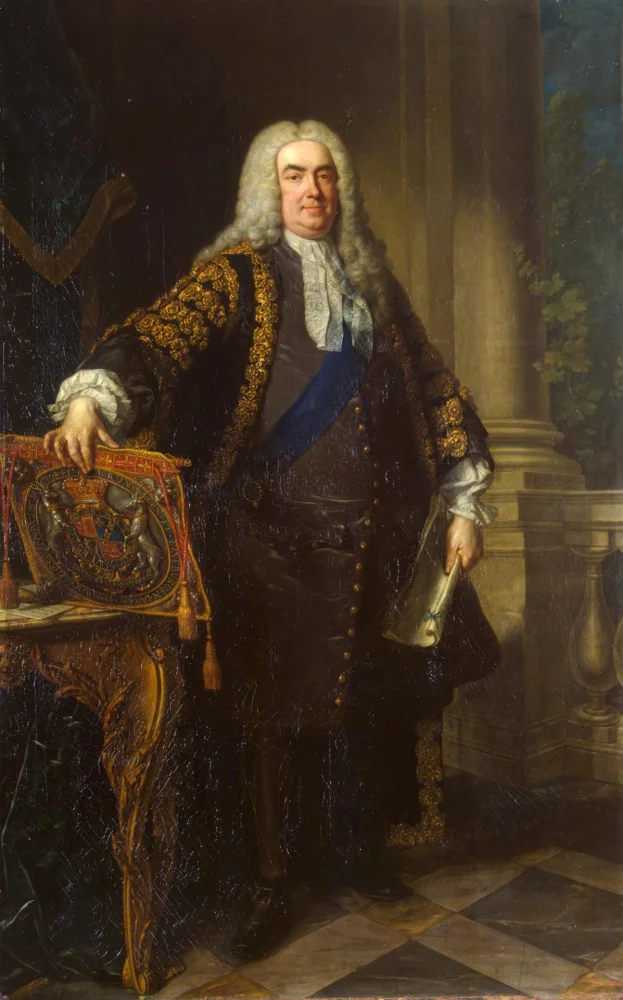
Robert Walpole became the central figure in British politics for more than two decades, governing through the reigns of George I and George II. Although the title “prime minister” was not then an official office, historians generally regard him as Britain’s first in practice. His long command of Parliament helped shape the modern role of the head of government.
Childhood and Education
Walpole was born on 26 August 1676 at Houghton in Norfolk, the fifth of seventeen children of landowner and Whig politician Robert Walpole and Mary Burwell. He was educated at Eton and entered King’s College, Cambridge, in 1696. His studies ended when his eldest brother died in 1698, making Robert the heir to the family estate. He returned to Norfolk to learn estate management and married Catherine Shorter, daughter of a wealthy timber merchant, in 1700.
Early Political Career
Walpole entered Parliament in 1701 and established himself as an effective Whig speaker and organizer. He served as secretary at war from 1708 to 1710 and treasurer of the navy from 1710 to 1711. When the Tories came to power, he was accused of corruption, expelled from the House of Commons, and imprisoned in the Tower of London in 1712. The charges were regarded by many Whigs as politically motivated, and his imprisonment helped make him a party figurehead.
The Whigs returned to office in 1715, and Walpole held senior government posts. He became First Lord of the Treasury and Chancellor of the Exchequer in 1721, following the collapse of the South Sea Company’s speculative boom. The crash had shaken public confidence in political and financial institutions. Walpole helped arrange a response that restored confidence in government credit and strengthened his standing with George I and in Parliament.
Power at the Center of Government
From 1721 to 1742, Walpole maintained the government’s parliamentary majority through political negotiation, party management, and the use of patronage. Opponents called him the “Screen-Master General,” suggesting he controlled politics from behind the scenes. His command of the Commons and ability to keep ministers aligned were crucial to the long stability of his administration, but his critics also accused him of manipulating Parliament and rewarding supporters.
Walpole generally favored avoiding expensive foreign wars and preserving trade and financial stability. In 1733, however, his proposal to change the taxation of wine and tobacco through an excise system provoked intense public and parliamentary opposition. Protesters feared the measures would expand government surveillance and taxation. Walpole withdrew the plan, a major retreat that exposed the limits of his authority.
He lived at 10 Downing Street from 1735, after persuading George II to make the house an official residence for First Lords of the Treasury rather than a personal gift to him. The decision helped establish the building’s lasting connection with the office of prime minister.
Family and Houghton Hall
Walpole and Catherine had several children, including Horace Walpole, who became a writer, collector, and political figure in his own right. Catherine died in 1737. In 1738 Robert married Maria Skerrett, with whom he had a daughter; Maria died the following year.
Walpole also pursued a passion for art and architecture. He built Houghton Hall, a grand Palladian country house in Norfolk, and assembled a major collection of paintings there, including works by celebrated European artists. The collection was sold by his grandson to Catherine the Great in 1779 and became part of the Hermitage collection in Russia.
War, Resignation, and Final Years
Walpole’s preference for caution abroad became increasingly difficult to sustain amid worsening relations with Spain. Britain declared war in 1739, despite his reluctance to embrace the conflict. Opposition over the conduct of the war, political divisions, and parliamentary setbacks eroded his grip on power. In February 1742 he resigned. He was elevated to the House of Lords as the Earl of Orford.
Legacy
Walpole died in London on 18 March 1745. He is remembered as a political operator who made the government more durable by securing dependable support in the House of Commons and managing the Crown’s ministers through Parliament. The label “first prime minister” is a later description of the power he accumulated as First Lord of the Treasury, not a title formally bestowed on him. His career also left a more complicated reputation: praised for restoring public credit and maintaining stability, he was attacked for patronage and criticized when his tax and foreign policies failed to hold public support.


