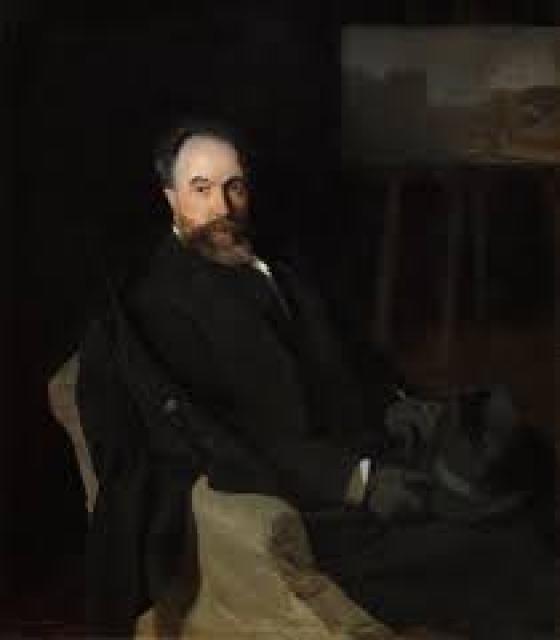
Aureliano de Beruete y Moret
 Spain
Spain- Aureliano de Beruete, 1845–1912
- Political Career and Transition to Art
- Artistic Influences and Landscape Painting
- International Connections and Pre-Impressionism
- Second Artistic Phase and Recognition
- Travel and Final Years
- Last Turn: Impressionism and Legacy
- Painting Style and Contributions
Aureliano de Beruete, 1845–1912
Early Life and EducationBorn into a family of Spanish social and political elite in 1845, Aureliano de Beruete y Moret (later known as Aureliano de Beruete) initially studied law at the University of Madrid, graduating in 1867. During his studies, he began painting under the guidance of Carlos Múgica and frequented the Museo del Prado as a copyist.
Political Career and Transition to Art
Beruete's political career began in the 1870s as an elected deputy in the Cortes. However, the Pavía coup d'état in 1873 led him to abandon politics and devote himself fully to painting.
Artistic Influences and Landscape Painting
In 1874, Beruete enrolled at the Academy of Fine Arts in Madrid as a student of landscape painter Carlos de Haes. The teachings of Haes and the intellectual circle of the krausistas, led by Nicolás Salmerón and Francisco Giner de los Ríos, strongly influenced his artistic development. Beruete's early landscapes often depicted idyllic scenes inspired by Spanish literature, such as his portrayal of Orbajosa.
International Connections and Pre-Impressionism
In 1878, Beruete traveled to Paris, where he encountered artists such as Martín Rico. Through Rico, Beruete became acquainted with the Barbizon group and adopted their plein air approach to painting. His subsequent works exhibited a lighter, more impressionistic style, exemplified by his participation in the National and International Exhibitions of Fine Arts.
Second Artistic Phase and Recognition
After 1891, Beruete's painting entered a second phase, influenced by the works and techniques of Velázquez. His landscapes became more individualized, characterized by bold brushstrokes and a shift away from the academicism of his earlier pieces. His artistic evolution continued with a series of illustrations for the "National Episodes" of Benito Pérez Galdós.
Travel and Final Years
Throughout his career, Beruete traveled extensively, both in Spain and internationally. His love of music led him to attend the annual Bayreuth Festival. In his later years, he made frequent visits to spas in Vichy. Despite his growing artistic prowess, Beruete's exhibition ratings declined. Nevertheless, he remained an influential figure, giving a notable inaugural address on the new Velázquez Salon at the Museo del Prado in 1899.
Last Turn: Impressionism and Legacy
From 1903 onwards, Beruete's paintings exhibited a distinct shift towards impressionism, influenced by his friendship with Darío de Regoyos. He continued to travel and paint, capturing scenes from the Swiss Alps, the Eastern Pyrenees, and the Castilian countryside. Beruete's passing in Madrid in 1912 marked the end of an illustrious artistic career that had greatly contributed to the development of Spanish landscape painting.
Painting Style and Contributions
Beruete's early artistic style was initially heavily influenced by Haes's naturalism. However, his subsequent contact with pre-Impressionist painters in Paris led to a lighter, more impressionistic approach. Beruete's unique perspective on Spanish landscapes, combined with his understanding of krausista philosophy, set him apart as one of the most significant landscape painters of the 19th century.