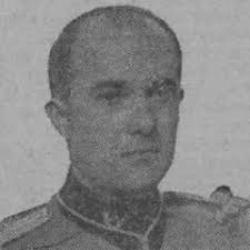
Avgust fon Makenzen
 Germany
Biography of August von Mackensen
Field Marshal, who conducted a series of successful military operations during the First World War. Son of a manor manager. On October 1, 1869, he voluntarily joined the 2nd Leib Hussar Regiment (Lisewo). He participated in the Franco-Prussian War of 1870-71. He became a reserve lieutenant in 1870. In 1873, he returned to service in the 2nd Leib Hussar Regiment. From 1876, he served as an aide-de-camp to the 1st Cavalry Brigade (Königsberg). From 1880, he served in the General Staff, and from 1887, he was the commander of the squadron of the 9th Dragoon Regiment, and from 1888, he served in the staff of the 4th Division. From 1891 to 1893, he served as an aide-de-camp to the Chief of the Great General Staff, General Alfred von Schlieffen. In 1892, he published a two-volume study on the history of the "Black Hussars" regiment. From 1894, he was the commander of the 1st Leib Hussar Regiment (during the World War, this regiment was named after Mackensen), stationed in Danzig. From 1898, he was an adjutant to the Kaiser. From 1900, he was the commander of the 1st Leib Hussar Brigade. In 1903, he became a lieutenant general and the commander of the 36th Division. From 1908, he was the commander of the XVII Corps, with which he entered the war as part of the 8th Army under General Maximilian von Prittwitz und Gaffron in East Prussia. During the battle with the units of the 1st Russian Army under General Pavel Rennenkampf near Gumbinnen on August 7 (20), Mackensen's corps came under heavy artillery fire and, suffering significant damage, retreated in panic, losing up to a third of its forces. In the Battle of Tannenberg, while his corps was on the left flank of the army, Mackensen on August 13 (26) overran the VI Russian Army Corps and, linking up with the I Army Corps advancing on the right flank, encircled the 2nd Russian Army under General Alexander Samsonov. On August 16 (29), Mackensen's corps was concentrated near Allenstein for possible resistance to the units of the 1st Russian Army. In mid-September, Mackensen's corps became part of the newly formed 9th Army under General Field Marshal Paul von Hindenburg on the Eastern Front. In the beginning of the Warsaw-Ivangorod operation on September 25 (October 8), under Mackensen's command, the "Mackensen" strike group (XVII, XX, and Combined Army Corps) was formed (as part of the 9th Army). On September 26 (October 9), Mackensen began an offensive through Radom and Bialobrzegi towards Warsaw. He had some success, but was unable to achieve the main goal of capturing Warsaw. From November 11, 1914, he became the commander of the 9th Army. On November 22, 1914, he was awarded the Pour le Merite order. During the Lodz operation from October 29 (November 11) to December 6 (19), 1914, Mackensen's army (155,000 soldiers and 960 guns) covertly moved to the Thorn area and was tasked with striking from the Thorn area to Kutno, bypassing Lodz. On October 29 (November 11), he began the offensive, but despite numerical superiority, he failed to achieve his goal - the destruction of the V Siberian Army Corps under General Lev Sidorin. He then developed an offensive on the Gniezno-Thorn line, flanking and attacking the rear of the main forces of the Russian army located on the left bank of the Vistula. After a series of battles, the right wing of the Russian army near Lodz was almost cut off, and only the movement of numerous Russian reinforcements from Warsaw, as well as the difficult situation of the group under General Richard von Schubert-Boyadel, forced Mackensen to withdraw his flanking forces. As a result of these actions, the Russian command was forced to abandon the invasion of Germany and switch to defense. On June 3, 1915, he received oak leaves to the Pour le Merite order. From April 16 to September 15, 1915, he commanded the 11th Army, formed from the most combat-ready corps, including those arriving from the Western Front - the Combined, Guard, XLI Reserve, and X Army Corps; in addition, the army included the VI Austro-Hungarian Corps and the 11th Cavalry Division (a total of about 357,000 soldiers, 1,606 guns, and 756 mortars). On April 19 (May 2), he launched an offensive and broke through the defense of the 3rd Russian Army under General Radko-Dmitriev on the Gorlice-Tarnów line, after which Russian forces were expelled from Galicia. On May 21 (June 3), his forces captured the fortress of Przemysl. Forced to halt the offensive after Italy entered the war and heavy fighting on the San River, Mackensen resumed the attack on June 2 (15). On June 9 (22), his troops took Lviv. From July 5, 1915, to July 1, 1918, he was the Commander-in-Chief of Army Group "Mackensen," initially operating in Poland. Under his command, the forces took the fortress of Brest-Litovsk at the end of August 1915. On June 13 (26), 1915, Mackensen's group (the 11th German and 4th Austro-Hungarian armies) began an offensive between the Vistula and Bug Rivers. The operation proceeded slowly, and by mid-July, Mackensen reached the Belzyce-Krasnostaw-Grubeshov line. After that, the offensive stalled, and Mackensen was unable to advance further beyond the Lublin-Chelm line, and the overall situation on the front stabilized. In October 1915, Mackensen was entrusted with the command of the German, Austro-Hungarian, and Bulgarian forces concentrated against Serbia. In total, under his command, there were 14 German and Austro-Hungarian divisions (along the Sava, Danube, and Drina rivers) and 6 Bulgarian divisions (along the eastern border). By the beginning of the offensive, Mackensen achieved more than a 3-to-1 numerical advantage in crossing directions. After conducting an artillery preparation on October 6, during which about 5,000 civilians were killed in Belgrade, Mackensen began the crossing of the Sava and Danube rivers on the Šabac-Rama front on October 7. On October 9, Mackensen's forces took Belgrade. On November 10, parts of the 11th Army captured Nis and joined forces with the 1st Bulgarian Army. As a result of the operation, by the beginning of December, the entire territory of Serbia was occupied. In the last third of 1916, under Mackensen's overall command, German, Bulgarian, and Turkish forces were combined with the task of withdrawing the Romanian army from the war and occupying Romanian territory. In early September, Mackensen crossed the Bulgarian-Romanian border into Dobruja, and on August 27 (September 9), he took Silistra. On August 31 (September 13), the Russian Dobruja Army retreated to the Cobadin position (Rahova-Cobadin-Tuzla). After receiving reinforcements, on August 6 (19), Mackensen resumed the attack and, capturing the Cobadin position, on October 10 (23) he took Constanța, and on October 11 (24) he took Chernovtsy and Medjidie. On November 21 (December 4), Romanian forces surrendered Bucharest without a fight. By the end of December, Austro-German forces reached the line of the lower Danube-Brașov-Focșani-Okna-Dorna-Vatra and switched to positional warfare. From January 1917, he commanded the occupation forces in Romania, and from May 11 to December 2, 1918, he was the Commander-in-Chief of the troops in Romania. In early 1919, due to the conditions of the armistice, Mackensen was forced to leave Romania and retreat back to Germany. However, he himself, along with his staff, was interned in Hungary, and as a result, his troops were given the right to continue moving through German roads to Germany after surrendering their weapons. Then, at the request of the French command, Mackensen was transferred to Thessaloniki, from where he was only released in November 1919. Upon his return to Germany, he immediately retired. He was considered one of the most talented military leaders of the First World War and was very popular in post-war Germany. He became a patron of the youth union "Jungsturm" in 1921 and actively participated in the activities of various soldier and veteran organizations. After the NSDAP came to power, he was appointed as a state counselor of Prussia. In 1935, after the death of Hindenburg, Mackensen became the only surviving field marshal of the First World War. His popularity was actively fueled by Nazi propaganda. He authored memoirs. Materials from the book: Zaleski K.A. Who was who in World War II. Allies of Germany. Moscow, 2003.