Baldwin VII
 Belgium
- Baldwin VII of Flanders: The Stern Count
- Rule under French Protection
- Conflict with His Mother
- Law and Order
- Broken Marriage and Diplomatic Alignment
- Illness, Death, and Succession
Baldwin VII of Flanders: The Stern Count
Early Life and AccessionBaldwin VII (c. 1093-1119) was the son of Robert II, Count of Flanders, and Clemence of Burgundy. From the House of Flanders, he became Count in 1111 after his father's death, known as Robert II of Jerusalem.
Rule under French Protection
King Louis VI of France confirmed Baldwin's rights and knighted him shortly after his accession. This move aimed to counter the claims of Baldwin III, Count of Hainaut, a descendant of Arnold III of Flanders, who had been deprived of Flanders by Baldwin's grandfather, Robert the Frisian. Thus, the French king secured Baldwin's support against King Henry I of England.
Conflict with His Mother
Initially, Baldwin shared power with his mother, Clemence, in the Flemish part of Burgundy. However, they clashed in 1113 when Clemence claimed lands that Robert II had granted her, constituting nearly a third of Flanders. Baldwin saw this as an encroachment on his authority. He sought the support of Bishop Lambert of Arras, appealed to the Flemish government, and even called upon the French king to intervene. Despite these efforts, he only succeeded in gaining limited control over his mother's lands.
Law and Order
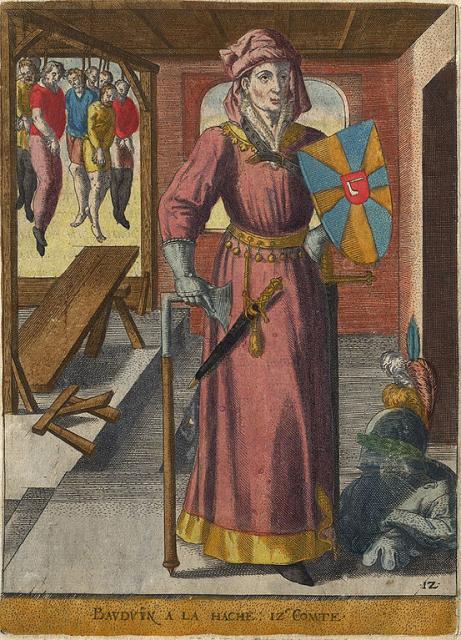
Like his predecessors, Baldwin supported towns and markets. He implemented measures to maintain law and order in the county, including combating raids and cracking down on criminals, outlaws, and rebellious nobles. Notable adversaries included Walter II, Count of Hesdin, and Hugh II, Count of Saint-Pol. Baldwin eventually reached peace agreements with both. By supporting the towns against the nobility, Baldwin earned the nickname "Hacha," meaning "axe."
Broken Marriage and Diplomatic Alignment
Baldwin married Hawise of Brittany in 1110, but their marriage was annulled by Pope Paschal II due to consanguinity. This shift in events led to Baldwin siding with King Louis VI of France against his wife's father, Alan IV, Duke of Brittany, who favored King Henry I of England.
Illness, Death, and Succession
Throughout his reign, Baldwin was aided by his cousin Charles the Good, who also served as regent when Baldwin participated in campaigns in Normandy in 1117 and 1118. In 1119, Baldwin fell gravely ill and died on June 17th of that year. He had no children, leaving the main branch of the House of Flanders without an heir. Before his death, he named Charles of Denmark as his successor, who was sworn in by the Flemish nobility and his mother, Clemence. Shortly before his passing, Baldwin entered a monastery. He died en route to Wijnendale Castle and was buried at Saint-Bertin in Saint-Omer on June 19th, in the presence of his heir and foreign dignitaries.