Simplicius
- A bishop in a changing Rome
- Church life and public works
- Theological conflict with Constantinople
- A pontificate at the threshold
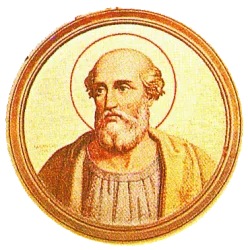
Simplicius was bishop of Rome during one of the great turning points of late antiquity. His pontificate began while the western Roman emperors still ruled from Italy and continued beyond the deposition of the last emperor in 476. As political authority shifted, Simplicius worked to maintain the church’s life in Rome and defend its theological position in disputes reaching across the Mediterranean.
A bishop in a changing Rome
Little is known about Simplicius’s early life. Later church tradition identifies him as a native of Tivoli and the son of a man named Castinus, but the surviving record of his papacy is much fuller than the record of his childhood. He became bishop of Rome in 468 and served until his death on March 10, 483.
In 476, the Germanic commander Odoacer deposed the young emperor Romulus Augustulus and took control of Italy. The Western Roman Empire, as a separate imperial court, came to an end. The change was momentous, but Odoacer retained much of the existing civil administration, and the church in Rome continued its work. Simplicius had to navigate a new political landscape while preserving the institution’s independence and stability.
Church life and public works
Simplicius is associated with the restoration and dedication of churches in Rome, including San Stefano Rotondo, a distinctive circular church on the Caelian Hill. Later accounts also credit him with arranging regular worship in important basilicas outside the city walls, such as St. Peter’s and St. Paul’s. These efforts helped maintain the city’s religious life at a time when its imperial government was changing.
He also worked with the political authorities to safeguard church property and regulate the choice of future bishops. The arrangements reflected a delicate reality: the Roman church needed cooperation from whoever governed Italy, while seeking to keep control of its own affairs.
Theological conflict with Constantinople
Simplicius’s papacy also unfolded amid disputes over the Council of Chalcedon and the nature of Christ. In 482, Eastern Roman Emperor Zeno issued the Henotikon, an attempt to reconcile divisions between Christians who accepted Chalcedon and those who rejected parts of its teaching. Simplicius opposed measures that he believed compromised the council’s authority and pressed the patriarch of Constantinople to defend the accepted doctrine.
This disagreement foreshadowed a lasting rupture between Rome and Constantinople. Simplicius died before the dispute fully developed into the Acacian Schism, which began under his successor, but his letters show Rome asserting its role in doctrinal questions even as imperial power in the West receded.
A pontificate at the threshold
Simplicius’s importance lies in the steady leadership he provided during a period of political transformation. The fall of the western emperors did not immediately erase Roman institutions; instead, the church adapted to rulers who now held power in Italy and maintained ties with the eastern empire. By supporting church life in Rome and defending Chalcedonian teaching, Simplicius helped carry the papacy into a new age.