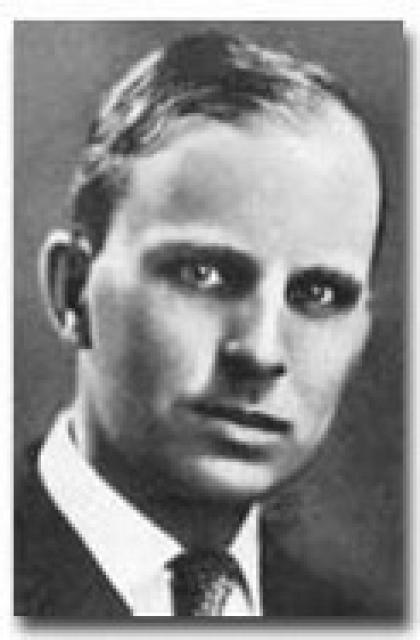
Benjamin Anderson
 USA
USA- Benjamin Anderson: A Prominent Economist of the Austrian School
- Academic and Professional Career
- Return to Academia and Legacy
Benjamin Anderson: A Prominent Economist of the Austrian School
Early Life and EducationBenjamin Anderson was born into a family of influence in Columbia, Missouri. At the tender age of 16, he enrolled at the University of Missouri, where he earned his Bachelor's degree in Arts in 1906. Subsequently, he taught political economy and sociology at Missouri Valley College before taking on the role of department head at the State Normal School in Springfield, Missouri. In the years that followed, he obtained a Master's degree in Arts from the University of Illinois and a doctoral degree from Columbia University. His doctoral dissertation, titled "Social Value: Theory, Critical, and Constructive," was later published.
Academic and Professional Career
After completing his doctorate, Anderson assumed the role of lecturer at Columbia University and later Harvard University. During this period, he published his seminal work, "Value of Money," which critiqued the prevailing quantitative theory. In 1918, he left Harvard for the National City Bank of New York. After a brief stint there, Chase Bank secured his services as an economist and editor of the "Chase Economic Bulletin."
During his time at Chase, Anderson became a fervent critic of progressive policies spanning finance, agriculture, taxation, and international economics. He vehemently opposed the New Deal and championed the gold standard.
Return to Academia and Legacy
In 1939, Anderson returned to the academic realm as a professor of economics at the University of California, Los Angeles, where he remained until his untimely death in 1949 from a heart attack.
Beyond his academic accomplishments, Anderson was an accomplished chess player, contributing a foreword to José Raul Capablanca's renowned book, "A Primer of Chess" (1935). His writings and teachings continue to influence economists and policymakers to this day, establishing his legacy as a significant contributor to the Austrian school of economics.