Bonaventura Cavalieri
 Italy
ItalyBiography of Bonaventura Cavalieri
Early Life and Education
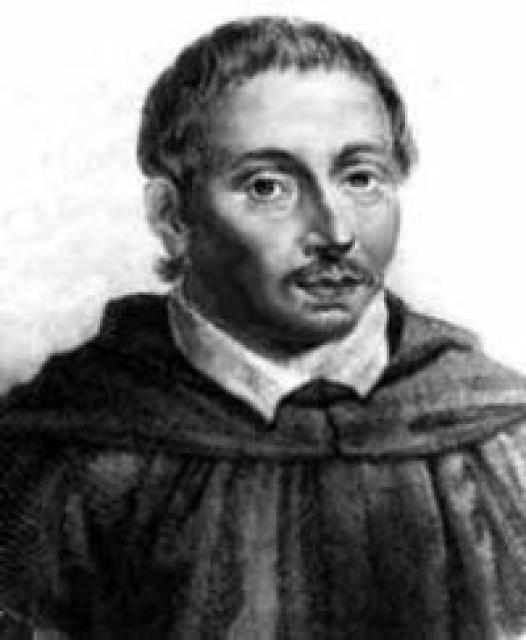
Bonaventura Cavalieri, an Italian mathematician and the precursor of mathematical analysis, was born in Milan. At a young age, he entered the monastic life and studied mathematics in Pisa under the guidance of Benedetto Castelli, a follower and friend of Galileo Galilei. Through Castelli, Cavalieri became acquainted with Galileo, who was living in Florence at the time.
Contributions to Mathematics
By the end of 1621, Cavalieri had made significant progress in developing the method of indivisibles and engaged in correspondence with Galileo, discussing the admissibility of decomposing figures into infinitely small elements. In 1629, when a chair of mathematics became vacant in Bologna, Cavalieri presented a manuscript of his completed work on indivisibles geometry. His candidature was strongly supported by Galileo, who characterized the young scientist as the "rival of Archimedes."
Academic Career and Later Life
Cavalieri worked as a professor at the University of Bologna until the end of his life. He was appointed as the head of a monastery by Pope Urban VIII, who favored him. However, his later years were overshadowed by a severe form of gout, which led to his premature death at the age of 49.
Major Works
Cavalieri authored several works on trigonometry, logarithms, geometric optics, and more. However, his most significant contribution was the treatise "Geometry, developed in a new way using continuous indivisibles" (1635), and its continuation, "Six Geometrical Studies" (1647). In honor of Cavalieri, a crater on the moon is named Cavalerius.