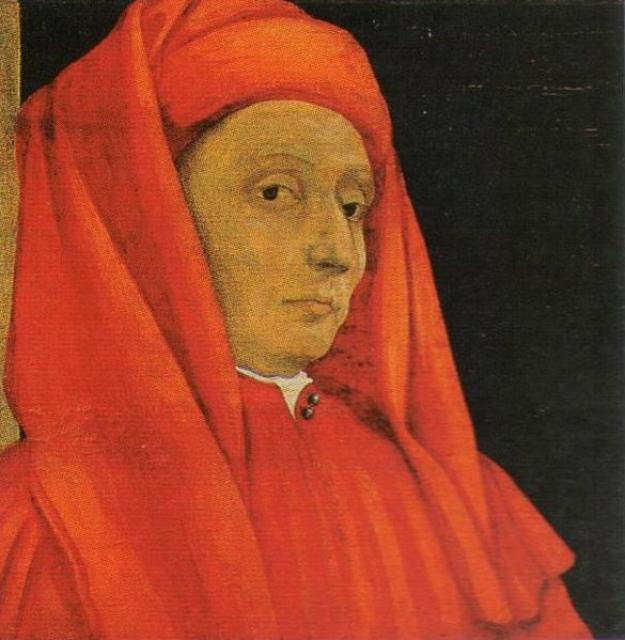
Bondone Giotto
 Italy
ItalyBiography of Giotto di Bondone
Giotto di Bondone was an Italian artist and architect of the Renaissance period. He is considered a key figure in the history of Western art. Giotto broke away from the Byzantine iconographic tradition and became the true founder of the Italian school of painting, as well as developing a completely new approach to representing space. He was born in 1267, presumably in Colle di Vespignano, near Florence. It is believed that he was a student of Cimabue. After completing his training, Giotto worked in various cities across Europe for twenty years, including Avignon, Ferrara, Naples, Padua, Ravenna, Rome, Verona, Rimini, and others. In 1311, he became a member of the Florentine guild of painters. From 1328 to 1333, Giotto served as the court artist to King Robert of Naples. In 1334, he became the chief architect of Florence and designed the campanile (bell tower) of the Santa Maria del Fiore Cathedral. Giotto passed away on January 8, 1337, and was buried in the Santa Maria del Fiore Cathedral. He was a key figure in the history of Western art, breaking away from the Byzantine iconographic tradition and founding the Italian school of painting. The exact date of Giotto's birth is debated among sources. However, contemporary research suggests that 1267 is the most convincing date, although other variations have been proposed, ranging up to 1275. The place of his birth is also a subject of dispute. While most scholars believe that Giotto was born in Colle di Vespignano in the Mugello Valley, some Italian scholars prefer the 18th-century version that he was born in Florence, in the parish of Santa Maria Novella, in the district of San Pancrazio. Giotto's father, named Bondone (who passed away between 1311 and 1313), is described as either a peasant or a blacksmith in different sources. The family owned land in Vespignano, and Giotto later acquired more land and houses there. Giotto is believed to have received his artistic education in Florence, in the workshop of Cimabue, around 1282-1287. However, this view is not widely shared by contemporary researchers. Around 1288, the upper church of San Francesco in Assisi began to be painted. Whether the young Giotto was involved in this work, and when exactly, remains uncertain. It seems plausible to identify the young Giotto with Master Isaac, who gained increasing independence in painting the upper church from the 1290s onwards. It is also likely, as stated by Vasari, that Giotto was commissioned by the Franciscan order's prior, Giovanni da Murovalle, in 1296, to paint 28 scenes from the legend of St. Francis. During this period, Giotto also created the famous Ognissanti Crucifix from the Santa Maria Novella Church in Florence and the Madonna of San Giorgio alla Costa. In the year 1300, Giotto's Navicella mosaic, which may have already been completed in Rome, gained him fame throughout Italy. In 1301, Giotto is mentioned as the owner of a house in Florence in a document. By the beginning of the 14th century, Giotto was already married. His wife, Ciuta di Lapo del Pela, gave birth to eight children, one of whom became a painter. Between 1303 and 1306, Giotto created his most important work, the frescoes in the Arena Chapel in Padua. Under his direct supervision, the central nave was painted, while the frescoes on the walls of the apse belong to the school of Giotto and were executed after 1317. It is also possible that Giotto worked in Rimini before Padua, between 1300 and 1303. After completing his work for Enrico Scrovegni, Giotto may have stayed in Padua for another year. According to sources, he depicted a celestial sign in the Palazzo della Ragione (the city hall) based on the instructions of the astronomer Pietro d'Abano, who returned from Paris to Padua only in 1306. Giotto then painted the Onions of St. George, which he completed around 1310. In 1309, a document dating from approximately that year mentions a certain merchant from Assisi who became Giotto's creditor. In September 1312, Giotto rented a loom to Bartolo Rinucci for six months, setting a monthly rent at an annual rate of 120%, while the normal rate was 50%. The contract, titled "Giotto the painter," who resided at Santa Maria Novella in Florence, was notarized by Lapo di Gianni, a friend of Dante. From court records, it is known that Giotto usually hired two notaries to collect his debts, and in 1314, there were even six of them. Between 1312 and 1315, Giotto is mentioned in the records of Florentine notaries. The Ferrarese chronicler Rikkobaldo recorded between 1312 and 1313 that Giotto was famous in Italy and was credited with frescoes in the Franciscan churches of Assisi, Rimini, Padua, and the Arena Chapel in Padua. It can be speculated that Giotto's stay at the papal court in Avignon took place between 1325 and 1318, when the artist is not mentioned in Florentine notarial records. Therefore, Vasari's statement that Giotto returned from Avignon in 1316 is not entirely unfounded. If the frescoes by Giotto in the Peruzzi Chapel of the Florentine basilica of Santa Croce are dated to 1318 or even earlier, taking into account his stay in Avignon, it would indicate an extremely intensive work schedule. Around 1320, Giotto presumably painted the cross vaults of the lower church of San Francesco in Assisi, if the stylistically attributed works indeed belong to him. In Florence, Giotto was admitted to the guild of the Arte dei medici e degli speziali (physicians and apothecaries) in 1320, which also accepted painters. In 1325, it can be assumed that Giotto began painting the Bardi Chapel in the basilica of Santa Croce in Florence. Around the same time, he acquired land in Colle di Vespignano. Numerous documents testify to Giotto's activities at the Angevin court in Naples from 1328 to 1333. In 1330, King Robert I granted him the title of familiare, or court painter. As Florence did not want to lose its famous citizen at the court of King Robert, the city authorities appointed him as the director of all construction works in the city in the spring of 1334, including the construction of the cathedral. The Florentine government sent Giotto to Milan in 1337 to create frescoes for Azzone Visconti. Shortly after his return, Giotto passed away in Florence on January 8, 1337 (1336 according to the Florentine calendar).


