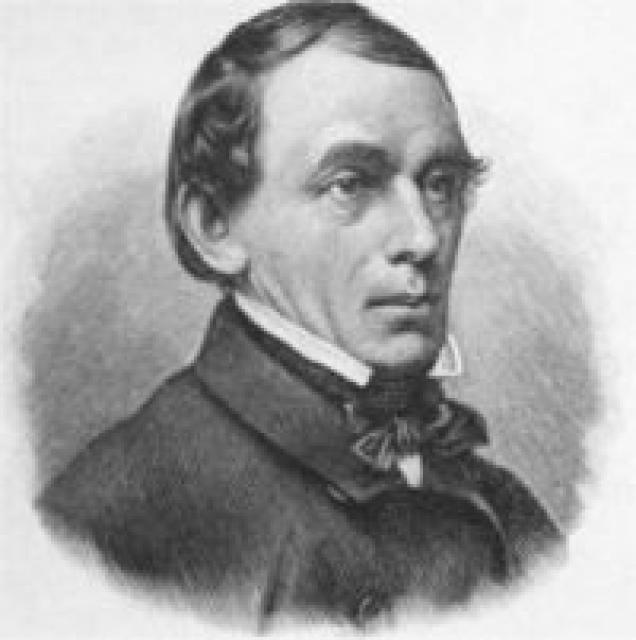
Borden Boun
 USA
USABiography of Borden Bowne
Borden Parker Bowne was an American philosopher and Methodist theologian, best known as the founder of personalism. He was born near Leonardville, New Jersey in 1847. His father, Joseph Bowne, was a farmer, Methodist preacher, and abolitionist, while his mother came from a Quaker family and was also an abolitionist. Borden was one of six children, and his parents were a model of high morality, advocating for the dignity of all people.
Education and Career
Borden Bowne attended New York University from 1867 to 1871, where he earned his bachelor's degree. During this time, he also obtained a certificate and began serving in the Methodist Church. In 1872, he was ordained as a deacon and appointed to a parish on Long Island. From 1873 to 1874, he continued his studies at universities in Europe, including Paris, Halle, and Göttingen. The philosophy of Lotze had the most significant influence on Bowne's worldview.
After working as a journalist in New York City from 1874 to 1876, Borden Bowne defended his master's dissertation at New York University in 1876. He then began his career as a professor at Boston University, where he remained until his death. Bowne served as the dean of the philosophy faculty and became the first director of the university's graduate program in 1888. He presided over the defense of the dissertation of John Wesley Edward Bowen, the first African American to earn a Ph.D. in philosophy in the United States, in 1891.
Contributions to Philosophy
Borden Parker Bowne's teachings can be described as a descriptive version of Kantian philosophy, distinguishing itself from didactic, formalistic, and logical versions. While he followed the traditions of Lotze, Bowne placed greater emphasis on the empirical roots of our knowledge. He made a clear distinction between conceptual assumptions and real evidence, viewing the primary function of logic as organizing thoughts. Bowne's method was an example of phenomenology, which was based not on pure logic but on the assumption that a thorough examination of an object reveals its origin and structure, leading to more detailed descriptions. The maximum that can be expected from knowledge is more or less useful guidelines for action. In his teachings, Bowne emphasized the practical nature of faith, later referred to as the pragmatism of belief or the scientific method of consolidating faith.
Bowne criticized traditional philosophical concepts of matter and existence in his metaphysics, proposing the notion of process as a foundation. This led him to be classified as an idealist. Bowne himself believed that his variant of pluralistic objective idealism was fully compatible with the existence of a reality far beyond our understanding. However, such a reality cannot be considered entirely independent, as nothing can be entirely independent at the level of existence. The key principle in Bowne's metaphysics became the concept of personhood. Regardless of what we think about the origin and nature of reality, that nature is in line with, or at least does not contradict, the existence of persons. The inevitability of any philosophical doctrine lies in the fact that they all express the viewpoints and values of individuals. Thus, personality becomes an element of relationships that we can confidently use as a central element of objective reality and, in turn, all philosophical constructions. Bowne criticized the "non-personal" philosophies of his time. Absolute idealism sacrifices the clear empirical multitude of personalities, on which our experience is based, in favor of an impersonal Absolute. Materialism reduces personal reality to an impersonal principle, which becomes a complete abstraction. According to Bowne, non-personal versions of naturalism and psychologism suffer from similar problems. Personalism remained the focus of philosophers until the 1930s. In theology and ethics, it endured much longer and received a powerful impetus thanks to Pope John Paul II.




