Boris Elyashevich
 Lithuania
- Early Life and Education
- Karaite Teacher and Cantor
- Preservation of Karaite Culture
- Under Soviet Rule
- Return to Eupatoria and Later Years
- Legacy and Achievements
- The establishment of the "Karay Bitikligi" library-museum
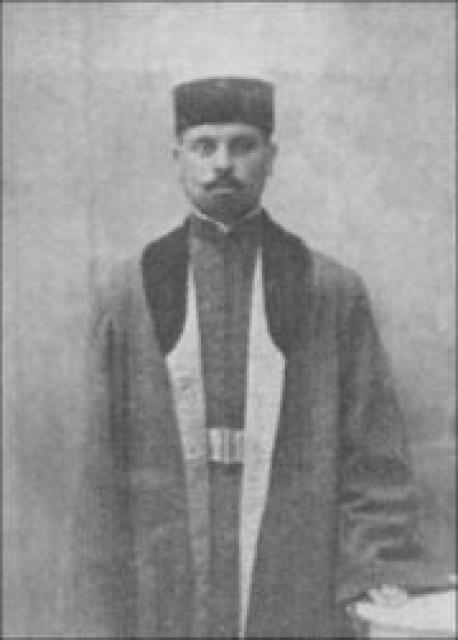
Boris Sa'adyevich Elyashevich (Berachyah-Ezriel ben Sa'adya Elyashevich)
Boris Sa'adyevich Elyashevich, also known as Berachyah-Ezriel ben Sa'adya Elyashevich, was a prominent Karaite religious leader, scholar, and cultural activist. Born in Panevėžys, Lithuania, on March 13 (26), 1881, he dedicated his life to serving the Karaite community.
Early Life and Education
Elyashevich's family moved to Moscow in 1892, where he received his initial Karaite and Russian education from his father, Sa'adya Semyonovich. In 1895, he enrolled in the newly established Karaite Teacher Training School in Eupatoria. After graduating with distinction, he returned to Moscow for his military service.
Karaite Teacher and Cantor
Upon completing his military service, Elyashevich returned to Eupatoria and began his 18 years as a Karaite teacher. In 1915, he was appointed deputy to the Karaite spiritual leader, Seraya Marcovich Shapshal. Elyashevich also possessed a gifted voice and organized a choir of Karaite students, which became renowned for its harmonious singing.
Preservation of Karaite Culture
In the early 1920s, facing the threat of Soviet suppression, Elyashevich became the custodian of the "Karay Bitikligi" library-museum. For nine years, he tirelessly guarded the Karaite cultural heritage housed in the library. When the library faced imminent closure, he intervened and negotiated its preservation. Valuable Karaite manuscripts were transferred to the Saltykov-Shchedrin Library in Leningrad and the Lenin Library in Moscow, ensuring their survival.
Under Soviet Rule
After the closure of the "Karay Bitikligi" in 1929, Elyashevich was forced to move to the Moscow suburbs due to his father's illness. Despite his religious status, which rendered him ineligible for government employment, he worked as a clerk and music teacher. In the early 1930s, he and his father were summoned by the NKVD, but Elyashevich refused to renounce his spiritual calling, enduring persecution as a "disenfranchised person."
Return to Eupatoria and Later Years
In 1946, the Karaite community of Eupatoria invited Elyashevich to return and serve as their cantor. He resumed his religious duties, which included leading worship services, organizing community events, and safeguarding the local Karaite cemetery. Elyashevich served as cantor until 1958, when he retired due to ill health. He passed away in Eupatoria on January 9, 1971, and is remembered as a dedicated advocate for the Karaite faith and culture.
Legacy and Achievements
Throughout his life, Elyashevich played a pivotal role in preserving and promoting Karaite heritage. He was a prolific writer, producing numerous articles, books, and documentary records. His scholarly work focused on Karaite history, literature, and liturgy. Elyashevich's legacy includes:
The establishment of the "Karay Bitikligi" library-museum
The preservation of valuable Karaite manuscriptsThe revitalization of the Karaite community after World War II
The documentation and dissemination of Karaite knowledge
Inspiring generations of Karaite scholars and activists