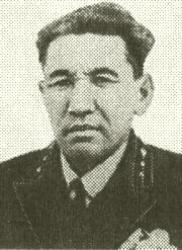
Bronislav Antilevskij
 Poland
Biography of Bronislaw Antilevsky
Bronislaw Romanovich Antilevsky was born in a peasant family and was of Polish descent. He completed seven years of school and in 1937, he graduated from a technical school in accounting. He joined the Red Army in October 1937 and underwent training at the Monino Aviation School from November 1937 to June 1938. In July 1938, he was assigned to serve as a radio operator in a long-range bomber squadron during the Soviet-Finnish War.
During the war, Antilevsky fought as part of the 21st long-range bomber aviation regiment and the 27th long-range bomber aviation brigade of the Northwestern Front. The regiment faced heavy losses and on April 7, 1940, Antilevsky was awarded the title of Hero of the Soviet Union for his bravery and achievements.
In September 1940, he enrolled in the Kachin Red Banner Military Aviation School. After completing his training in April 1942, he participated in the Great Patriotic War as a pilot in the 20th Fighter Aviation Regiment. He flew Yak-9 fighters and took part in the August battles of 1942 near Rzhev. He was promoted to the rank of lieutenant on September 17, 1942, and appointed as a flight leader on December 15, 1942.
In February 1943, the 20th Fighter Aviation Regiment was included in the newly formed 303rd Fighter Aviation Division of the 1st Air Army of the Western Front. Antilevsky and his fellow pilots were responsible for escorting bombers and ground-attack aircraft. They had the challenging task of protecting the bombers while flying at low altitudes and often engaged in combat under unfavorable conditions.
On April 15, 1943, Antilevsky was appointed as a deputy squadron commander. The 20th Fighter Aviation Regiment specialized in escorting bombers and ground-attack aircraft, and their work was highly appreciated by bomber and ground-attack pilots. They were known for their dedication and courage in protecting their comrades.
In July 1943, Antilevsky was promoted to the rank of senior lieutenant. However, on August 28, 1943, he was shot down during an aerial battle and became a prisoner of war. The Soviet authorities revoked his Hero of the Soviet Union title and stripped him of the Lenin and Red Banner Orders.
In the fall of 1943, influenced by Colonel Maltsev of the Russian Liberation Army (ROA), Antilevsky voluntarily joined the ROA. He participated in the recruitment of Soviet prisoners of war and former Soviet citizens who were against the Stalinist regime.
In October 1943, Antilevsky was involved in the formation of the 1st Aviation Regiment of the ROA Air Force. The regiment was headquartered in Heuberg and commanded by Colonel Baidak, a former officer of the Russian Imperial Air Force.
Antilevsky served as the commander of the 2nd Assault Squadron, which was later renamed the 2nd Night Assault Squadron. The squadron carried out operations in support of the ROA's offensive actions against Soviet partisan groups.
After the disbandment of the ROA's aviation units in September 1944, Antilevsky arrived in Eger and played an active role in the formation of the 1st Aviation Regiment of the ROA Air Force.
The regiment was composed of five squadrons: fighter, assault, reconnaissance, transport, and training/support. Antilevsky was appointed as the commander of the 2nd Assault Squadron, which was later transformed into the 2nd Night Assault Squadron.
In April 1945, the squadron conducted its first combat missions in support of the ROA's offensive on the Oder Front. The squadron attacked Soviet positions and provided air cover for the ROA's ground forces.
On April 30, 1945, Antilevsky surrendered to the Americans in Langdorf. He hoped that the contradictions between the Allied powers would prevent his extradition to the Soviet Union. However, the conditions of surrender were not favorable, and he, along with other ROA members, had to rely on personal guarantees from American officers to avoid being handed over to the Soviets.
After the war, Antilevsky's fate is unknown. He was likely repatriated to the Soviet Union, where he faced possible imprisonment or punishment for his involvement with the ROA.