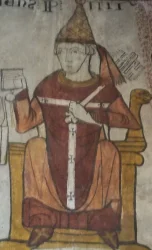
Urban III
Urban III was pope from 1185 to 1187, during a period of sharp conflict between the papacy and Holy Roman Emperor Frederick Barbarossa. Born Uberto Crivelli into a Milanese family, he had served as a cardinal and archbishop before his election. His short pontificate was marked by disputes over imperial power in northern Italy and the succession to the Kingdom of Sicily.
A Milanese churchman
Uberto Crivelli was born in Milan around 1120. He became a cardinal in 1182 and was appointed archbishop of Milan in 1185, shortly before the death of Pope Lucius III. Crivelli was elected pope in November that year and took the name Urban III.
The conflict between Rome and Frederick Barbarossa had deep roots. The emperor sought to strengthen his authority in Italy, while the pope defended the independence and territorial interests of the church. As archbishop of Milan, Urban had experienced the consequences of this struggle directly: Frederick’s forces had destroyed the city in 1162, and members of the Crivelli family had suffered during the conflict.
Imperial and Sicilian disputes
Relations worsened in 1186 when Henry, Frederick’s son, married Constance of Sicily, the heiress to the Norman kingdom in southern Italy. The marriage and Henry’s coronation as king of Italy in Milan took place without Urban’s approval. The prospect that the Hohenstaufen dynasty might unite imperial power with Sicily threatened the papacy’s position in central Italy.
Urban tried to rally support among German bishops and to resist the expansion of imperial influence. Frederick, however, maintained the upper hand in northern Italy, and the pope remained in Verona rather than establishing himself in Rome. Urban eventually moved to Ferrara as the political crisis continued.
Final days and legacy
In 1187, news of the Christian defeat at Hattin and the capture of Jerusalem by Saladin reached Europe. Urban died in Ferrara on October 20, 1187, shortly after reports of Jerusalem’s fall reached the papal court. Later writers linked his death to grief over the disaster, but the precise cause is not known. His successor, Gregory VIII, issued the call that helped launch the Third Crusade.
Urban’s pontificate was brief, but it reflected the wider struggle over whether the emperor or the pope would hold the stronger position in Italy. His conflict with Frederick also showed how dynastic marriages could reshape the balance of power in the Mediterranean.