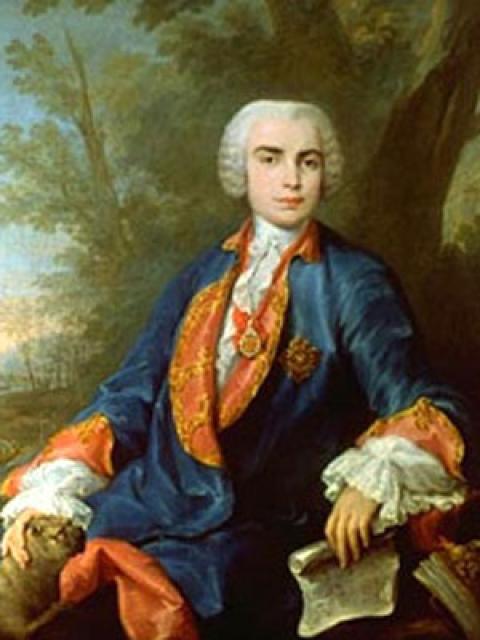
Carlo Farinelli
 Italy
Italy- Biography of Carlo Farinelli
- Early Career and Success
- International Success and Royal Patronage
- The Spanish Court and Legacy
- Later Years and Legacy
Biography of Carlo Farinelli
Early Life and TrainingCarlo Farinelli, born Carlo Broschi, was an Italian opera singer (soprano) and castrato. He was born on January 24, 1705, in Andria, Apulia. Unlike most young singers who were castrated due to their families' poverty, Carlo came from a noble family. His father, Salvatore Broschi, was the governor of the cities of Maratea and Chisterino and later a conductor in Andria. Carlo showed exceptional singing abilities from a young age and underwent castration at the age of seven to preserve the purity of his voice. He adopted the stage name Farinelli, derived from the surname of the Farina brothers who supported him during his early years. Carlo initially studied singing with his father and later at the Neapolitan conservatory "Sant'Onofrio" under the renowned musician and singing teacher Nicola Porpora, who had trained other famous singers such as Caffarelli, Porporino, and Montagnana.
Early Career and Success
At the age of fifteen, Farinelli made his debut in Naples in Porpora's opera "Angelica and Medoro." He gained widespread recognition for his performances at the Teatro "Aliberti" in Rome during the 1721-1722 season, where he sang in operas by Porpora and Prevedi. Farinelli impressed audiences with his vocal virtuosity and expressive singing style. He gained particular fame for his ability to sustain long phrases and navigate the three-octave range of his voice. His performances captivated both critics and audiences, establishing him as one of the greatest singers of his time.
International Success and Royal Patronage
In 1734, Farinelli traveled to England, where he performed at the Royal Theatre. He became a sensation and was hailed as a musical genius. Farinelli's vocal talents and virtuosic abilities garnered him immense popularity and the admiration of the English public. His performances were met with overwhelming applause, and he received a substantial salary as well as generous rewards from admirers, including Prince of Wales and the Spanish ambassador. Farinelli's success continued when he traveled to France, where even the typically critical French audience was charmed by his singing.
The Spanish Court and Legacy
In 1737, Farinelli was invited to Spain by the Spanish queen to help alleviate the depression and mental instability of King Philip V. His singing had a profound impact on the king, who experienced significant improvement in his condition. Farinelli became an essential figure in the Spanish court and was appointed as the personal singer to the king and queen. He devoted his performances exclusively to the royal couple, singing four favorite arias each day. Although he did not perform publicly during this period, Farinelli's influence and power at the Spanish court were immense. He later became the director of the royal theaters and introduced Italian opera to Spain, bringing renowned composers and singers to perform.
Later Years and Legacy
After the death of King Philip V, Farinelli continued to serve under the new king, Ferdinand VI. However, his duties became less demanding, allowing him to focus on his personal pursuits. He retired from public singing and lived a life of luxury in his lavish house near Bologna. Farinelli indulged in his love for arts and sciences and enjoyed playing the harpsichord and viola. He entertained distinguished guests and fellow artists, including Gluck, Haydn, Mozart, and the princes and princesses of Europe. Carlo Farinelli passed away on September 16, 1782, leaving behind a legacy as one of the greatest singers of all time. His exceptional vocal abilities, virtuosity, and expressive singing style continue to inspire and awe audiences to this day.




