Charles Dufresne
 France
- From Apprenticeship to the École des Beaux-Arts
- Algeria and a Distinctive Palette
- War, Exhibitions and Design
- Murals and Lasting Recognition
Charles Dufresne was a French painter, printmaker, sculptor and decorator whose art drew on both modern movements and older, theatrical traditions. Born into a seafaring family, he left school young and learned through work, night classes and later formal study. A two-year stay in Algeria transformed his palette and subject matter, while his later career ranged from war art to opera design and public murals.
From Apprenticeship to the École des Beaux-Arts
Dufresne was born in Millemont on November 23, 1876. His family had maritime roots, and his early path was practical rather than academic: he left school at eleven, worked with a commercial artist and studied drawing in evening classes. He later attended the École des Beaux-Arts in Paris, but financial necessity also led him to work in a sculptor’s studio.
Pastels from around 1906 began to attract notice, and he held his first exhibition in 1908. The varied training helped shape an artist comfortable moving between painting, sculpture, engraving and decorative design.
Algeria and a Distinctive Palette
In 1910, Dufresne won the Prix de l’Afrique du Nord, which funded a stay of about two years in Algeria. The strong light and vivid colors of North Africa left a lasting mark. Works associated with this period, including Algerian landscapes and scenes of local life, show how he absorbed the region’s visual atmosphere without settling into a single school.
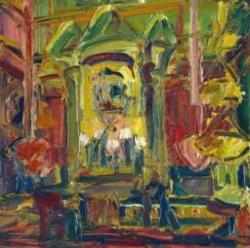
His paintings took elements from Fauvism and Cubism, yet remained recognizably his own. He joined modernist experiments with a taste for dramatic composition, saturated color and subjects drawn from myth, travel and everyday life.
War, Exhibitions and Design
Dufresne served during the First World War, was badly gassed, and later joined the camouflage section led by his friend André Dunoyer de Segonzac. His experiences produced drawings and watercolors that brought the conflict into his art.
After the war, he continued to work across disciplines. In 1923 he helped found the Salon des Tuileries, an exhibition society that offered artists another platform in Paris. He also designed theatrical settings and worked on decor for the Paris Opera, bringing his painter’s sense of color and staged movement into performance spaces.
Murals and Lasting Recognition
Near the end of his life, Dufresne received important mural commissions for public buildings in Paris. In 1938, he was commissioned to create five large paintings for an amphitheater at the École de Pharmacie. He died on August 8 of that year in La Seyne-sur-Mer, before the commission could define a long new chapter in his career.
Today, Dufresne’s work appears in museum collections in France and abroad. His legacy rests on the range of his practice and on a visual language that carried the color and light of Algeria into a modern French art shaped by both experimentation and tradition.