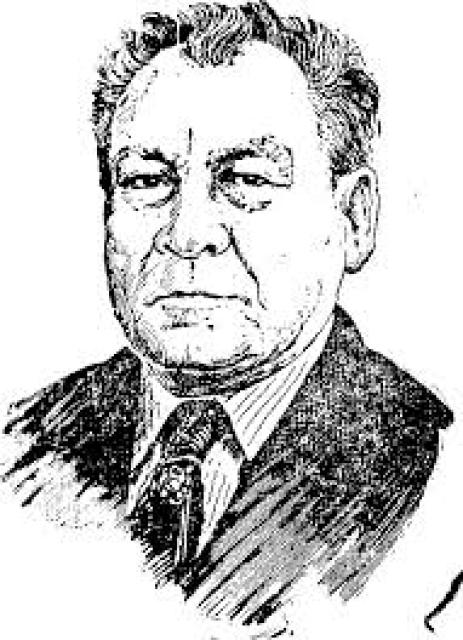
Charu Ashirov
 Turkmenistan
- Early Life and Education
- Literary Career
- "Bloody Resistance" (1939)
- Other Literary Contributions
- Translations
- Political and Social Involvement
Early Life and Education
Kerim Kurbannepesov was born into a peasant family in the village of Keshi, near Ashgabat. He completed his education at the Institute of Scientific Pedagogy.
Literary Career
Kurbannepesov's literary journey began in 1928 with his first publication. He published numerous collections of lyrical poems, including:
"Bloody Resistance" (1939)
"Separation" (1939)"In Enemy Territory" (1941)
"The Young Miller's Mistake" (1957)
Notable Works
Kurbannepesov's most famous work is the poem "The End of the Bloody Watershed" (1948), which depicts social transformations in the Turkmen village during the 1920s. This poem inspired the libretto for the eponymous opera by Veli Mukhatov, staged at the Turkmen Opera and Ballet Theater in 1967.
Other Literary Contributions
Kurbannepesov collaborated with D. Zotov on the novel "Road to Victory" (1939). He also authored the novel "The Pathfinder" (1970), which explored the lives of Soviet border guards.
Translations
From the 1940s onwards, Kurbannepesov actively translated works of Russian and Ukrainian classics into Turkmen, including the works of Taras Shevchenko.
Political and Social Involvement
Kurbannepesov joined the Communist Party in 1944. He was awarded the Order of the Red Banner of Labor and the title of People's Writer of Turkmenistan in 1970.


