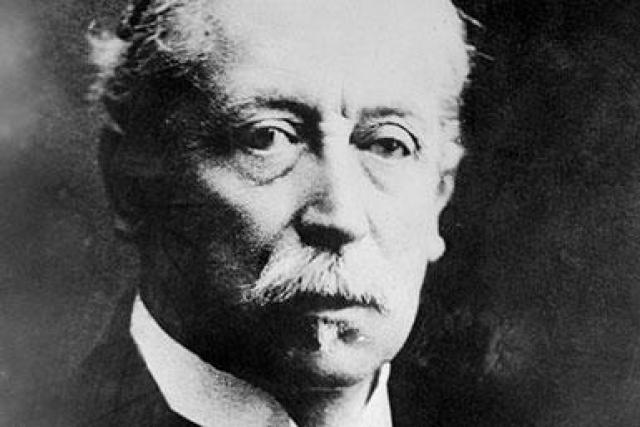
Christian Eijkman
 Netherlands
Biography of Christiaan Eijkman
Christiaan Eijkman was a Dutch physician and pathologist who was awarded the Nobel Prize in Physiology or Medicine. He was born to schoolteacher parents, Christian Eijkman and Johanna Alida Eijkman (née Pul), and was the seventh child in the family.
Early Life and Education
At the age of 17, Eijkman received a scholarship to study at the Military Medical School of the University of Amsterdam and serve in the army. Due to his outstanding academic performance, he became an assistant to a professor teaching physiology at the university. In 1883, Eijkman completed his medical degree with distinction, having written a doctoral dissertation titled "On Polarization of Nerves." In the same year, he married Aaltje Wigeri van Edema and began his military service.
Research in Berlin
After recovering from a severe bout of malaria, Eijkman moved to Berlin to work with Robert Koch. Here, he gained significant experience in the field of bacteriology, which was a revolutionary science at the time, offering new perspectives on the study and treatment of various diseases. Initially, it was believed that all avitaminoses (diseases caused by vitamin deficiencies), including beriberi and pellagra, were infectious. However, American physician Joseph Goldberger discovered that pellagra was not caused by an infectious agent.
During this time, Robert Koch discovered that tuberculosis is caused by the tubercle bacillus, leading to the hypothesis that many other diseases could also be caused by similar microorganisms. In Koch's laboratory, Eijkman met two members of the Dutch Medical Commission, Cornelius Pekelharing and Clemens Winkler, who sought Koch's assistance in studying the problem of beriberi, a disease prevalent in the Dutch East Indies (now Indonesia). As Koch was too busy to participate in the commission's work, he offered Eijkman the opportunity, which he gladly accepted. In 1886, Eijkman traveled to Java.
Beriberi Research
Beriberi was a well-known and widespread disease at the time, not only in Java but also among Japanese sailors. The disease was first described by a Dutch physician in the early 1600s. For many years, beriberi remained a serious problem for prisoners in Java, and imprisonment was essentially a death sentence. There were at least two theories connecting beriberi to the diet, particularly the consumption of rice. Some believed that toxic substances in rice caused the symptoms, while others believed that the lack of fats and proteins in rice was the cause.
In his experiments with chickens, Eijkman discovered that they developed paralysis similar to beriberi when fed polished rice. However, when he fed them unpolished rice, the chickens remained healthy. This led him to investigate the role of different types of rice in the development of beriberi in humans. He found that prisoners who consumed polished rice had a 300 times higher incidence of beriberi compared to those who consumed unpolished rice. In 1890, Eijkman published an article titled "Poly-neuritis in Chickens," describing the similarities between polyneuritis and human beriberi, as well as his findings regarding rice. He hypothesized that polished rice may contain a toxin that causes the disease.
In 1911, Polish chemist Kazimierz Funk isolated a substance from rice bran that prevented the development of beriberi. This substance, now known as thiamine or vitamin B1, was absent in polished rice. Funk coined the term "vitamine" (later changed to "vitamin") to describe these essential substances. Eijkman's research in Java laid the foundation for the discovery of methods to treat many diseases associated with nutrient deficiencies. In 1929, Eijkman and Frederick Gowland Hopkins were awarded the Nobel Prize for their contributions to the discovery of vitamins. However, Eijkman was too ill to personally receive the award. He retired in 1928 and passed away in Utrecht in 1930.
Throughout his career, Eijkman was a member of the Royal Netherlands Academy of Arts and Sciences, an elected foreign associate of the National Academy of Sciences in the United States, and an honorary member of the Royal Institute of Public Health in London. He received several noble titles and the Dutch government established the Eijkman Medal in his honor.