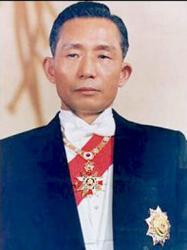
Chung-hee Park
 South Korea
Park Chung-hee: Biography
Park Chung-hee was born on September 30, 1917, in a poor peasant family in South Korea. He received his military training under Japanese instructors at the Manchurian Military Academy, graduating at the top of his class in 1942. During World War II, he served in the Japanese forces in Manchuria. His skills as a young officer caught the attention of the American occupying forces, who were looking for suitable candidates to establish the South Korean army. Those selected, after undergoing retraining, formed the core of the South Korean National Defense Army.
In 1948, Park was accused of collaborating with communists and was expelled from the army. However, considering his subsequent actions, this accusation seems unfounded. In June 1950, the Korean War broke out, and Park was called back into the army.
In March 1960, South Korea was shaken by a political crisis. Syngman Rhee was overthrown on charges of election fraud. By this time, Park held the position of Deputy Commander of the 2nd Army and held the rank of Major General. The position of Prime Minister was filled by Chang Myon, an inexperienced and incapable individual. The ruling circles of the country were searching for a "strong personality" who could "restore order," and Park quickly emerged as the ideal candidate. He received financial support from influential industrialists and financiers.
Formed by senior officers, the "Military Revolutionary Committee," which soon transformed into the Supreme Council for National Reconstruction (SCNR), announced the successful completion of the "military revolution" on the morning of May 16. Their statement promised to transfer power to civilians immediately after the "revolution's tasks" were completed. Thanks in large part to this coup led by Park Chung-hee, international recognition quickly followed.
The concentration of power in the hands of a small group of military leaders was accompanied by the establishment and growth of intelligence organizations and the increasing significance they held within the state apparatus. The Central Intelligence Agency, led by one of the coup's initiators, Colonel Kim Jong-phil, played a special role. The Democratic Republican Party (Minju Konhwadan) began to form under Kim Jong-phil's leadership in early 1962, a year before political activities were officially permitted. Park had to restrict Kim Jong-phil's ambitious attempts to monopolize power within the party and elevate it above the state, merging the party and state apparatus.
Park Chung-hee strongly opposed such tendencies, believing that power should remain the prerogative of the bureaucratic state apparatus.
To suppress opposition organizations by force, Park sanctioned the development of a series of legal acts, the vague provisions of which allowed any regime dissenters to be punished. Many leaders of the old parties were held accountable for anti-state activities and faced judicial responsibility. A few were executed, while the majority received prison sentences ranging from 5 to 15 years. Around 20,000 active opponents of the regime were imprisoned.
Park Chung-hee sought to control not only the political and economic life of the country but also its spiritual aspects. This goal was to be achieved through the movement for national "reconstruction," which began with a law passed on June 9, 1961.
Park Chung-hee managed to revitalize the country's economy within a short period. The well-being of the population started to improve, and giant industrial corporations gained strength.
As a result of the 1965 reform of secondary education, the number of professional and technical schools increased.
The military authorities took full control of education. A significant amount of study time was devoted to propagating the goals and tasks of the "military revolution."
Park Chung-hee sought to strengthen executive power in every way possible. To achieve this, he launched a campaign to revise the constitution. On December 17, 1962, a referendum was held in South Korea to decide on the adoption of a new constitution. The constitution came into effect in 1965.
On May 3, 1967, new presidential elections took place, and Park Chung-hee easily defeated Yun Bo-seon. The new phase of his rule was marked by an increase in repression. Although the ban on opposition parties was lifted, any form of opposition was harshly suppressed.
In 1971, Park was reelected, and he began to contemplate the next elections. On October 17, 1972, he unexpectedly declared martial law, banned all political activities, suspended the constitution, and dissolved the parliament.
The new dictatorial powers granted to Park led to serious disturbances in the cities, which were ruthlessly suppressed. In 1975, Park enacted a law prohibiting criticism of the government. With each passing year, Park Chung-hee's regime lost support and earned widespread public hatred.
Park's methods of governance, his desire to subjugate everyone to his will, and the terror that extended beyond just opponents but also targeted supporters of the regime led to a conspiracy within close circles.
Park Chung-hee died in November 1979 as a result of a brutal and mysterious assassination attempt. According to the official version, Park was shot by the head of the Korean intelligence, Kim Kyu, during a private luncheon. Kim engaged in a heated argument with one of the participants and shot him in a fit of rage. When Park tried to intervene, Kim shot him twice. Park's security guards rushed into the room, but Kim killed all four of them. This is the summarized account of the events provided by the South Korean mass media.