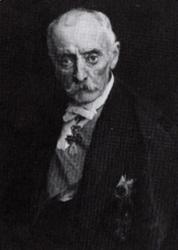
Cipriano Castro
 Venezuela
- Cipriano Castro: A Venezuelan Leader with a Tumultuous Reign
- Political Beginnings
- Conflict and Exile
- Rise to Power
- Presidency
- Government and Policies
- Overthrow and Exile
- Death and Legacy
Cipriano Castro: A Venezuelan Leader with a Tumultuous Reign
Early Life and EducationCipriano Castro was born into a farming family in San Cristóbal, Venezuela. He briefly attended seminary school in Pamplona, Colombia, before returning to his hometown to work for a company called Van Dissel, Thies y Ci'a. He later became a muleteer and eventually owned a plantation in the remote Andes region.
Political Beginnings
In 1876, Castro opposed the candidacy of General Francisco Alvarado as governor of Táchira. In 1878, he worked as the manager of the newspaper El Álbum and participated in the capture of San Cristóbal when they refused to accept the authority of the newly elected president.
Conflict and Exile
Castro's clashes with the authorities culminated in his arrest in 1884 for disputing with the parish priest. He escaped after six months and fled to Cúcuta, where he managed a hotel. He later became governor of his native province of Táchira but was exiled to Colombia in 1892 for attempting a coup d'état.
Rise to Power
While in Colombia, Castro spent seven years planning his seizure of power back home. He amassed a fortune through illicit cattle trading and raised a private army. In 1899, he led an uprising against President Ignacio Andrade Troconis, initially seeking an alliance with the Colombian-based liberal conspirator Carlos Rangel Garbiras. However, he failed to coordinate efforts with Garbiras and instead relied on the support of Juan Vicente Gómez, Manuel Antonio Pulido, José María Méndez, Emilio Fernández, Jorge Bello, and Pedro María Cárdenas.
Presidency
After several attempts, Castro gathered a force of about 60 men who denounced Ignacio Andrade's violation of the 1893 Constitution. They crossed the Colombian border on May 23, 1899, and marched towards Caracas. As he approached the city, Andrade resigned, and Castro entered and proclaimed himself ruler.
Castro's rebellion sparked a three-year civil war that culminated in the defeat of the liberals and ended the era of two-party conflict that had characterized Venezuelan history during the 19th century.
Government and Policies
The new government aimed to implement centrist reforms, reduce foreign debt, and modernize the armed forces along Prussian lines. However, the administration's early rule was marked by extreme arbitrariness and favoritism towards cronyism, leading to repeated uprisings. Foreign debt grew, primarily due to Venezuela's military involvement in Colombia's "Thousand Days War."
In 1901, Castro's policy of coercing local banks to lend money sparked the first of several uprisings, led by banker Manuel Antonio Matos. Venezuela's disregard for foreign creditors' interests resulted in the Venezuelan crisis of 1902-1903, which saw foreign powers intervening and blockading the country.
Despite these challenges, Castro managed to maintain power, although he faced ongoing conflicts. In 1908, a lawsuit against the New York & Bermúdez Company for 50 million bolivars and an attempt to expropriate the Orinoco Shipping Company led to a break in diplomatic relations between Venezuela and the United States. That same year, Venezuela's position on the Netherlands' military use of Curacao island and its harboring of Venezuelan refugees prompted Castro to requisition Dutch-flagged ships. Venezuela expelled the Dutch ambassador, leading to the dispatch of three Dutch warships to intercept Venezuelan-flagged vessels.
Overthrow and Exile
Castro left Venezuela to seek medical treatment for syphilis in Paris when, in December 1908, he was overthrown in a coup led by his vice president and close friend, General Juan Vicente Gómez, with the support of the US Navy. This effectively ended the conflict with the Netherlands.
In subsequent years, Castro faced discrimination and restrictions from the governments of various countries, including the US and France. His wife was allowed to return to Venezuela, where she was celebrated, but Castro remained in exile in Puerto Rico, making unsuccessful attempts to regain power.
Death and Legacy
After his death, Castro's remains were buried in the San Juan de Puerto Rico cemetery until they were repatriated in May 1975 and interred in a mausoleum in his hometown of Capacho.
In popular culture, Castro's tenure was a target of international satire due to his controversies and conflicts with European countries and the US. A vast collection of caricatures published worldwide was compiled by American scholar William M. Sullivan in the book "Cipriano Castro in World Caricature" (1980).
In the mid-20th century, Castro's character gained newfound attention in both historical and literary accounts. One of the most celebrated works about him is Mariano Picón Salas' "Days of Cipriano Castro" (1953), which won the National Literature Prize in 1954.
Castro was known by the nickname "El Cabito," translating the nickname Le petit caporal given to Napoleon Bonaparte, whom he often sought to emulate. El Cabito became a central figure in Pedro María Morantes' renowned novel "Pío Gil," which satirized the Liberal Restoration regime. In 2017, the film "La planta insolente" was released, based on the politician's life.