Claudio Castelucho
- Childhood and Background
- Education and Early Career
- Paris Studios and the Salon Years
- Style, Subjects, and Recognition
- Personal Ties and Later Years
- Legacy
Born into an artistic Barcelona family, Claudio Castelucho grew up among drawing, stage design, and the practical craft of making images convincing. He would spend most of his career in Paris, where he moved through the city’s studios and exhibition halls as both a painter and a sought-after teacher. His canvases often brought Spanish dancers, cafés, and bullfighting culture into the bright, bustling world of modern French art.
Childhood and Background
Castelucho was born in Barcelona on July 5, 1870. His father, Antoni Castelucho i Vendrell, was a respected draftsman and engraver who opened a drawing and painting academy in the city. Claudio’s younger brother Emili also became a painter, while his sisters Antònia and Enriqueta exhibited applied-art works. Their father gave all the children their first artistic lessons, making art a family trade as much as a vocation.
The young artist entered Barcelona’s official School of Fine Arts, La Llotja, where he studied portraiture with Antoni Caba and perspective with Lluís Rigalt. He earned several medals and two travel grants for further study, which took him to Madrid. There he copied and studied paintings by Diego Velázquez at the Prado, an influence he greatly admired.
Education and Early Career
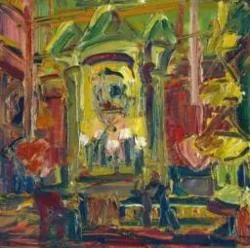
Castelucho began exhibiting while still a teenager. His first noted appearance came at Barcelona’s 1888 Universal Exhibition with a drawing of the main altar of the Royal Monastery of Poblet. He later showed at Sala Parés and other Barcelona exhibitions. Alongside his father, he co-authored two technical books on perspective: Tratado completo de perspectiva aplicada a las bellas artes y artes industriales (1891) and Escenografía teatral (1896), the latter applying perspective principles to theatrical decoration.
After visits to Paris in 1892 and 1895, he settled there with his family in 1897. In the early years he worked with his father and brother as a decorator on public and private commissions, while also pursuing illustration, poster design, and painting. His French Salon debut that year featured landscapes, including Després de la pluja (After the Rain) and Paisatge amb lliris (Landscape with Lilies).
Paris Studios and the Salon Years
The city gave Castelucho access to a lively network of artists and independent academies. He taught evening classes at the Académie Colarossi and also studied in James Abbott McNeill Whistler’s studio, where he served as an assistant instructor. Colarossi attracted a generation of Catalan artists in Paris, including Isidre Nonell, Ricard Canals, and Xavier Nogués.
In 1905, Castelucho joined the teaching staff of the Académie de la Grande Chaumière, founded the previous year by Martha Stettler and Alice Dannenberg. He became especially popular among international students, many of them women from the United States. His pupils included Australian painter Kathleen O’Connor, Canadian artist Edwin Holgate, and Americans Alice Pike Barney, Rose Hartwell, Maren Froelich, and Marie Cronin. His classes helped make him a familiar figure in Montparnasse and connected his career to the growing international art community there.
From 1897 onward, he exhibited regularly at Paris Salons. He appeared at the Salon de la Société des Artistes Français, the Salon de la Société Nationale des Beaux-Arts, the Salon d’Automne, and the Salon des Indépendants. He also showed in Munich, Berlin, Vienna, Frankfurt, Pittsburgh, Geneva, and London. His 1906–1914 period was particularly successful: before the First World War, he became one of the Catalan artists with the strongest international exhibition presence. In 1922 he was named an associate member of the Société Nationale des Beaux-Arts salon.
Style, Subjects, and Recognition
Castelucho painted portraits, theatrical interiors, cabarets, and dancers, often using a vigorous, brightly colored brushwork that became increasingly sketch-like over time. Spanish subjects remained a signature: flamenco performers, bullfighters, gypsies, and dance scenes answered the period’s appetite for images à l’espagnole. The critic Gardner Teall nicknamed him “the Sargent of Spain,” a comparison that reflected the attention paid to his portrait skill and color.
Among his best-known works are La bailaora (The Dancer), Dama en blanc (Woman in White), El tango, and La princesa i el mico (The Princess and the Monkey). His Portrait of Marie Cronin, painted in 1906, traveled to exhibitions across Europe and the United States and is now held by the Meadows Museum in Dallas. The Smithsonian American Art Museum holds La princesa i el mico, also known as Woman in Arbor with Monkey. Two 1917 paintings, a nude woman with a white mantilla and a seated woman in a kimono, entered the Museu Nacional d’Art de Catalunya’s collection through a family donation.
Personal Ties and Later Years
Although Paris became his base, Castelucho returned briefly to Barcelona around 1910 and again at the start of the First World War. During the war years he painted views of the city and family scenes, including Mercat de les flors, Barcelona (Flower Market, Barcelona). After returning to Paris, he resumed his regular participation in the salons and continued exploring Spanish subjects. He also maintained close ties with fellow Catalans. The writer and illustrator Lola Anglada visited his studio; their friendship led him to paint her portrait and inspired her later recollections.
Castelucho died in Le Plessis-Robinson, near Paris, on October 31, 1927, aged 57. His final Salon des Indépendants appearance came that year. The following year, both the Société Nationale des Beaux-Arts and the Salon des Indépendants mounted posthumous exhibitions, and a retrospective followed in 1931 at the family’s Salle d’Art Castelucho Diana in Montparnasse.
Legacy
For his own generation, Castelucho was a prolific and internationally visible painter, a fixture at Paris exhibitions, and a teacher valued by students from across the Atlantic. His work remained tied to academic training even as his handling of color grew freer. Much of it is now in private collections, and his public profile has faded, but museum holdings and exhibition records preserve the range of a career that linked Barcelona’s artistic traditions with Parisian modern life.